
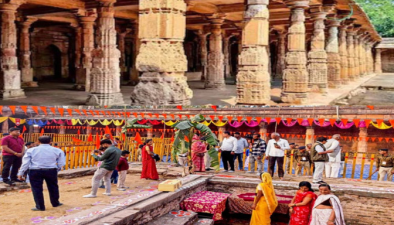
The Indore Bench of the Madhya Pradesh High Court, on May 15, 2026, declared the historic Bhojshala-Kamal Maula Mosque complex in Dhar district as a temple dedicated to Goddess Vagdevi, who is identified with Saraswati. A division bench comprising Justice Vijay Kumar Shukla and Justice Alok Awasthi delivered the 242-page judgment, establishing that the 11th-century structure was originally an institutional center of Sanskrit learning built during the Parmara dynasty. The landmark verdict completely quashed a April 7, 2003 administrative arrangement by the Archaeological Survey of India (ASI) that divided worship access between Hindu and Muslim communities on separate days of the week.
Archaeological Survey Findings and Evidence
The High Court heavily relied on a comprehensive, 10-volume scientific survey report submitted by the ASI. The multi-disciplinary investigation spanned 98 days and utilized advanced non-destructive tools to ascertain the architectural timeline of the monument.
Stratigraphic and Structural Analysis
- Earlier Foundations: Ground Penetrating Radar (GPR) and stratigraphic excavations revealed that a massive, precisely proportioned temple structure extended four to five meters below the modern ground level.
- Pillar Reuse: The complex incorporates 106 pillars and 82 pilasters. The survey confirmed these were salvaged from an older Hindu temple structure, highlighting a hasty, medieval reconstruction where multiple shafts were stacked unsymmetrically.
- Mihrab Modification: The structural evaluation showed that the western wall was deliberately cut and altered to insert the Mihrab (Islamic prayer niche), using materials distinct from the baseline Parmara-era masonry.
Recovered Artifacts and Epigraphy
- Sculptural Heritage: Archaeologists recovered and cataloged 94 intact or fragmented sculptures from the site. These include depictions of Ganesha, Brahma, Narasimha, Bhairava, and traditional motifs like tortoises, serpents, and elephants, which are completely absent in Islamic architecture.
- Sanskrit Inscriptions: Over 150 Sanskrit and Prakrit epigraphic inscriptions were documented on the stone slabs. Notable among these are two unique Sarpabandha (serpentine charts) and grammatical odes dedicated to the Kurma-Avatara (tortoise incarnation of Vishnu).
Core Legal Pronouncements
The division bench navigated specific historical, constitutional, and statutory paradigms to settle the religious character of the protected monument.
Applicability of the Places of Worship Act, 1991
The court clarified that the Places of Worship (Special Provisions) Act, 1991, does not apply to the Bhojshala complex. Section 4(3)(a) of the 1991 Act explicitly excludes any ancient or protected monument covered under the Ancient Monuments and Archaeological Sites and Remains (AMASR) Act, 1958. Since the site was designated a protected structure as early as 1904 under the colonial Ancient Monuments Preservation Act, its baseline protection remains governed by archaeological conservation laws.
Fundamental Right to Worship
Unlike property disputes fought as title suits, this litigation was evaluated under Article 226 of the Constitution as a writ petition for the enforcement of the fundamental right to worship under Article 25. The bench concluded that the historical continuity of Hindu rituals at the site, though regulated over time, was never legally extinguished.
Administration and Alternative Remedies
- Supervisory Control: The Government of India and the ASI retain exclusive administrative, conservation, and supervisory management over the property.
- Alternative Allocation: To preserve public peace and address the religious requirements of the local Muslim community, the court advised the state government to consider allocating alternative, permanent land within Dhar district for a mosque if requested by the Maulana Kamaluddin Welfare Society or a fresh Waqf body.
Historical Background of the Parmara Dynasty
The Bhojshala monument is inextricably linked to the zenith of the Parmara dynasty, which ruled the Malwa region of central India from the 9th to the 14th centuries CE.
Reign of Raja Bhoj (1010–1055 CE)
Raja Bhoj was the most celebrated monarch of the Parmara clan, famous as a military strategist, polymath, and patron of arts. He shifted the imperial capital from Ujjain to Dhar, transforming it into a major intellectual hub. He authored over 80 classical treatises covering diverse subjects, including Samarangana Sutradhara (architecture), Sarasvatikanthabharana (Sanskrit grammar), and Ayurveda Sarvasva (medicine). He established the Bhojshala in 1034 CE as an academy for higher Sanskrit studies, placing a consecrated image of Goddess Vagdevi at its center.
Medieval Transitions and Islamic Rule
The Malwa region faced repeated geopolitical incursions during the early medieval era. The complex was severely damaged in 1305 CE during the military expansion of Alauddin Khilji of the Delhi Sultanate. It was subsequently modified into a mosque complex during the 15th century under the regional Malwa Sultanate rule of Dilawar Khan and Mahmud Khilji, leading to the incorporation of the tomb of the Sufi saint Hazrat Maulana Kamaluddin Chishti adjacent to the compound.
IASPOINT Booster Facts for UPSC
- The Vagdevi Idol: The original 11th-century marble idol of Goddess Vagdevi, excavated from the Bhojshala ruins in the late 19th century by British political agent Major Kincaid, is currently housed in the British Museum in London. The High Court directed the Union government to consider legal avenues for its repatriation.
- Paramara Architecture: The Parmara rulers pioneered a distinct sub-school of the Nagara style of temple architecture, characterized by orthogonal plan structures, intricately carved stellar projections, and stepped curvilinear shikharas.
- The AMASR Act, 1958: This statute provides for the preservation of ancient and historical monuments, archaeological sites, and remains of national importance. It empowers the ASI to regulate excavations and run administrative upkeep within a 100-meter prohibited zone around protected sites.
- Waqf Creation Rule: The High Court observed that for a property to be legally treated as a mosque or Waqf asset, clear dedication by a creator (Waqif) must be established. A mere declaration or historical compromise (Ailan) issued by a princely ruler—such as the Dhar State declaration of 1935—cannot create a presumption of a Waqf property in the absence of original title deeds.