
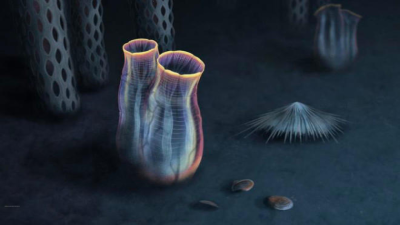
Researchers have recently made an exciting discovery in the field of paleontology. They have described a 500-million-year-old tunicate fossil species, shedding light on the early establishment of the modern tunicate body plan shortly after the Cambrian Explosion. The fossil, named Megasiphon thylakos, provides insights into the ancestral characteristics and life cycle of tunicates, suggesting that they lived as stationary, filter-feeding adults and underwent metamorphosis from a tadpole-like larva.
Understanding Tunicates
Tunicates, commonly known as sea squirts, are a diverse group of marine animals. They are typically found attached to surfaces such as docks, rocks, or the bottom of boats. With around 3,000 known species, tunicates inhabit various shallow water habitats in the world’s oceans. These marine invertebrates have an evolutionary history dating back at least 500 million years, making them a subject of great interest to researchers due to their close relationship to vertebrates, which include fish, mammals, and humans.
Tunicate Lineages: Ascidiaceans and Appendicularias
- There are two main lineages of tunicates: ascidiaceans and appendicularias. Ascidiaceans, often referred to as “sea squirts,” undergo a metamorphosis from a mobile, tadpole-like larval stage to a barrel-shaped adult. The adult ascidiaceans are attached to the seafloor, where they filter-feed to obtain nutrients.
- On the other hand, appendicularias, which are quite distinct from vertebrates, retain their tadpole-like appearance as they grow into adulthood. These tunicates have a free-swimming lifestyle in the upper waters.
Unique Features of Tunicates
Tunicates exhibit a wide range of shapes, sizes, and lifestyles, making them truly intriguing creatures. In their adult stage, tunicates typically have a barrel-like shape with two siphons projecting from their bodies. One siphon draws in water along with food particles through suction, allowing the tunicate to feed using an internal basket-like filter device. The other siphon expels the filtered water back into the environment.
The Discovery of Megasiphon thylakos
- The recent discovery of Megasiphon thylakos, a 500-million-year-old tunicate fossil species, has provided valuable insights into the early stages of tunicate evolution. This fossil reveals that ancestral tunicates, like their modern counterparts, lived as stationary, filter-feeding adults. The metamorphosis from a tadpole-like larva to an adult form was likely a characteristic of early tunicates.
- This discovery is significant because it suggests that the basic body plan of tunicates was established early in their evolutionary history, shortly after the Cambrian Explosion. The Cambrian Explosion was a period of rapid diversification of life forms that occurred around 541 million years ago. Understanding the early development and characteristics of tunicates contributes to our broader understanding of evolutionary processes and the origins of diverse marine life.
Implications for Evolutionary Studies
The fossil record provides crucial evidence for understanding the evolution of life on Earth. The discovery of Megasiphon thylakos contributes to our understanding of tunicate evolution and provides insights into the ancient marine ecosystems of the past. By studying the morphological and ecological characteristics of early tunicates, researchers can gain valuable information about the factors that influenced the diversification and survival of these organisms throughout geological history.