
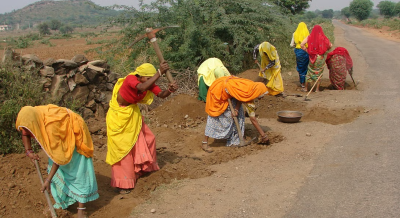
The Viksit Bharat – Guarantee for Rozgar and Ajeevika Mission (Gramin) Act, popularly called the VB–GRAMG Act, has triggered an intense debate on the future of India’s rural employment guarantee. Projected by the Union government as a reform that strengthens the right to work, the Act has instead been criticised for weakening the very principle of an employment guarantee that underpins the Mahatma Gandhi National Rural Employment Guarantee Act. The controversy goes beyond technical clauses and raises fundamental questions about rights-based welfare, federal discretion, and the State’s obligation to provide work.
The Government’s Case for VB–GRAMG
The most prominent defence of the new law has come from Union Rural Development Minister Shivraj Singh Chouhan. He has argued that the VB–GRAMG Act preserves the core guarantee of employment while expanding it from 100 days to 125 days per rural household annually, compared to the entitlement under Mahatma Gandhi National Rural Employment Guarantee Act (MGNREGA), enacted in 2005.
At first glance, this appears to be a clear expansion of workers’ rights. However, critics argue that this comparison overlooks a crucial design change that fundamentally alters the nature of the guarantee itself.
The ‘Switch-Off’ Clause and the Dilution of Guarantee
The central concern relates to Section 5(1) of the VB–GRAMG Act, which states that the employment guarantee shall apply only “in such rural area in the State as may be notified by the Central government”. This clause gives the Union government the discretion to decide where the guarantee applies.
In effect, this converts a universal, justiciable right into a conditional promise. An employment guarantee that can be selectively switched on or off by executive notification undermines the very logic of a rights-based programme. Critics argue that this is akin to offering a guarantee without guaranteeing its applicability.
It is also pointed out that increasing the entitlement to 125 days could have been achieved within the MGNREGA framework itself. In fact, some States already provide more than 100 days of work under existing provisions, without any new legislation.
The ‘Disentitlement’ Argument Explained
Another defence of the VB–GRAMG Act is that it removes so-called “disentitlement provisions” that allegedly denied workers their dues under MGNREGA. This argument refers to a clause in MGNREGA that temporarily disqualifies applicants from receiving unemployment allowance if they apply for work but later refuse an offered job.
This provision was originally introduced as a mild safeguard against frivolous applications. In practice, however, the problem it sought to address never materialised. Over nearly two decades, the clause has scarcely been invoked and has had no meaningful impact on workers’ access to employment or allowances.
As a result, critics contend that removing this clause is largely symbolic. It neither strengthens workers’ rights nor compensates for the far more consequential dilution introduced by discretionary applicability of the guarantee itself.
Normative Funding Versus Demand-Driven Rights
A more substantive justification for the VB–GRAMG Act is the proposed shift from demand-driven funding to “normative funding”. This argument has been articulated by economists such as Soumya Kanti Ghosh of the State Bank of India.
Under MGNREGA, funding follows demand: if eligible workers demand employment, the State is legally obliged to provide work or pay unemployment allowance. Normative funding, by contrast, involves predetermined allocations decided by the Centre.
Critics argue that once spending is capped by norms, these allocations effectively become budget ceilings. States are unlikely to exceed them, regardless of actual demand for work. This marks a shift away from a rights-based framework towards a discretionary welfare model, where access to employment depends on fiscal limits rather than legal entitlement.
Do Budget Caps Improve Equity Across States?
Supporters of normative funding claim that it will ensure a more equitable distribution of resources across States, addressing alleged imbalances under MGNREGA. However, empirical evidence does not support the claim that MGNREGA disproportionately favours better-off States.
High levels of MGNREGA employment per rural household are observed both in poorer States such as Chhattisgarh and in relatively better-off States like Tamil Nadu. Conversely, low employment levels are found in poorer States such as Bihar as well as wealthier ones like Gujarat.
If the objective is to support poorer States, critics argue that raising wage rates in those States would be a more effective and just approach than imposing budget caps, which may actually constrain States with high unmet demand for work.
Technology, Corruption and Ground Realities
Another pitch for the VB–GRAMG Act is that it will curb corruption through greater reliance on digital technologies. Yet most transparency measures, including social audits and electronic payments, already exist under MGNREGA.
Experience with digital systems in rural employment schemes has been mixed. While they have improved accountability in some respects, technical failures and rigid authentication requirements have also led to delayed wages and worker exclusion. In some cases, such as the diversion of wages to mobile wallets in the past, technology has inadvertently facilitated new forms of corruption.
Critics argue that the new Act displays an uncritical faith in technology, without adequately addressing these known shortcomings.
Rebranding Versus Reform
Several provisions highlighted by the Act’s supporters—such as time-bound wage payments and strengthened social audits—are substantially identical to existing MGNREGA clauses. Critics see this as repackaging rather than reform, aimed at centralising control and political credit.
This pattern, they argue, echoes earlier instances where rights-based legislation was rebranded into executive schemes, reducing transparency and weakening legal accountability under the Narendra Modi government.
What to Note for Prelims?
- Key differences between MGNREGA and VB–GRAMG Act
- Concept of demand-driven versus normative funding
- Employment guarantee as a legal right
- Role of Union discretion in welfare schemes
What to Note for Mains?
- Rights-based welfare versus discretionary schemes in India
- Fiscal federalism and Centre–State relations in social policy
- Implications of budget caps on employment guarantees
- Technology-led governance: benefits and risks for the poor