
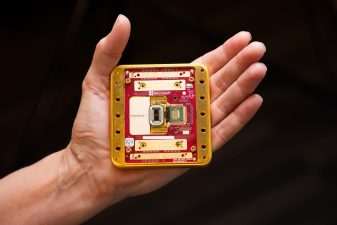
Recent advancements in quantum computing have been marked by Microsoft’s introduction of the Majorana 1 chip. This innovative chip uses Majorana particles to create a new type of qubit, enhancing stability and reliability. The Majorana 1 is poised to address the challenges faced by traditional quantum computers, such as error rates and scalability. This could pave the way for practical applications in various fields, including medicine and environmental science.
What Are Qubits?
Qubits are the fundamental units of quantum computers. Unlike classical bits that represent either a 0 or a 1, qubits can exist in multiple states simultaneously. This property allows quantum computers to perform complex calculations much faster than classical computers. The ability to process vast amounts of information makes qubits essential for tackling problems that are currently unsolvable.
Majorana Particles
Majorana particles are unique as they are their own antiparticles. This property makes them ideal for creating stable qubits. Microsoft’s Majorana 1 chip leverages topological superconductors to manipulate these particles. This results in qubits that are less susceptible to errors, which is advancement over traditional qubit designs.
Topoconductors and Their Function
Topoconductors are materials that combine properties of semiconductors and superconductors. Microsoft has developed a topoconductor made from indium arsenide and aluminium. When cooled to near absolute zero, this material allows for the control of Majorana particles. This control is crucial for the reliable operation of Majorana qubits.
Majorana 1 Chip Specifications
The Majorana 1 chip features eight qubits, which may seem limited compared to competitors like Google and IBM. However, its architecture is designed for scalability, potentially allowing it to reach one million qubits. This scalability is necessary for practical quantum computing applications, such as developing self-healing materials or tackling pollution.
Quantum Computing vs Classical and Supercomputers
Quantum computers operate on principles of quantum mechanics, using quantum gates to manipulate qubits. In contrast, classical and supercomputers rely on binary logic and classical bits. While supercomputers excel at performing calculations quickly, they remain limited by classical computing principles. Quantum computers can solve complex problems that are beyond the reach of traditional computing methods.
Future Applications of Quantum Computing
Quantum computing holds promise for numerous applications in science and industry. It could aid in understanding material properties, leading to innovations like self-repairing structures. Furthermore, combining quantum computing with artificial intelligence may enhance capabilities in data generation and model training, unlocking new possibilities in research and development.
Challenges Ahead
Despite the advancements, quantum computing faces challenges, particularly concerning error correction. Quantum systems are sensitive to their environments, leading to errors that must be corrected for practical use. Researchers continue to explore methods to improve error rates and develop more robust quantum systems.
Questions for UPSC –
- Critically analyse the significance of qubits in advancing quantum computing technology.
- What are Majorana particles? Explain their role in enhancing the stability of qubits.
- What is the difference between quantum computers and supercomputers? Illustrate with examples.
- Explain the concept of topoconductors and their importance in the development of quantum chips.
Answer Hints:
1. Critically analyse the significance of qubits in advancing quantum computing technology.
- Qubits can exist in multiple states simultaneously, allowing for parallel processing of information.
- This property enables quantum computers to solve complex problems exponentially faster than classical computers.
- Qubits are essential for tasks such as cryptography, optimization, and simulating quantum systems.
- Advancements in qubit technology, like those in Majorana 1, improve error rates and scalability.
- The development of reliable qubits is crucial for practical applications in various fields, including medicine and materials science.
2. What are Majorana particles? Explain their role in enhancing the stability of qubits.
- Majorana particles are unique as they are their own antiparticles, which is a rare property in physics.
- These particles can be manipulated to create more stable qubits, reducing error rates in quantum computing.
- Majorana particles exist in topological states, providing robustness against external disturbances.
- Their utilization in the Majorana 1 chip allows for the development of scalable quantum systems.
- Research on Majorana particles has the potential to revolutionize quantum computing and its applications.
3. What is the difference between quantum computers and supercomputers? Illustrate with examples.
- Quantum computers use qubits and quantum gates to perform calculations, while supercomputers rely on classical bits and logic gates.
- Quantum computers can solve problems that are infeasible for supercomputers, such as factoring large numbers or simulating quantum systems.
- For example, Google’s quantum chip Willow can solve complex computations in minutes that would take supercomputers millennia.
- Supercomputers excel at performing large-scale simulations but are still constrained by classical computing principles.
- Quantum computing represents a fundamentally different approach to computation, enabling breakthroughs in various fields.
4. Explain the concept of topoconductors and their importance in the development of quantum chips.
- Topoconductors combine properties of semiconductors and superconductors to create stable environments for qubits.
- Microsoft’s topoconductor is made from indium arsenide and aluminum, crucial for controlling Majorana particles.
- They enable the observation and manipulation of Majorana particles necessary for creating stable qubits.
- Topoconductors allow for the cooling of materials to near absolute zero, enhancing qubit performance.
- Their development is essential for scaling up quantum systems to millions of qubits for practical applications.