
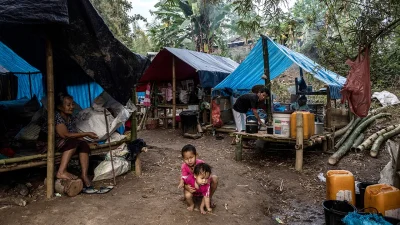
Myanmar is holding elections in a country at war with itself — but there is neither celebration nor belief. What is unfolding is not a democratic exercise but a carefully choreographed political performance by the military junta, aimed at manufacturing legitimacy nearly five years after the 2021 coup. Against the backdrop of civil war, displacement, and repression, the vote risks deepening Myanmar’s crisis rather than resolving it.
An election staged under the shadow of guns
The generals who overthrew Aung San Suu Kyi’s elected government in 2021 are now seeking validation through the ballot. Yet this election bears none of the hallmarks of democratic choice. Voting has been cancelled across large swathes of the country, opposition parties have been barred, and the National League for Democracy — the dominant political force of the past decade — has been dissolved.
With campaigning absent in many regions and public participation minimal, the outcome is foreordained. For most citizens, the ballot has little relevance amid daily struggles for safety, food, and survival. The exercise is political theatre, not representation.
A country fractured by civil war
The election is taking place amid a brutal nationwide conflict that has claimed an estimated 90,000 lives and displaced more than 3.5 million people. The military continues to rely on air strikes, village burnings, and drone attacks against its own population to retain control.
Such violence has hollowed out the very idea of national unity. Large parts of Myanmar — particularly in Rakhine, Kachin, and several border regions — lie beyond effective state authority. An election conducted in these conditions cannot reconcile a fractured society; instead, it risks hardening divisions and prolonging the war.
China’s calculus: stability over democracy
Recent months have seen a slowdown in rebel momentum, partly due to Beijing’s mediation efforts and pressure on certain ethnic armed groups. China’s interest, however, is narrowly strategic. Stability along its border and the security of economic corridors to the Indian Ocean take precedence over democratic outcomes.
For Beijing, the election offers predictability — a familiar military authority rather than an uncertain political transition. Any gains from ceasefires remain fragile, reflecting the limited reach of external influence in a deeply fragmented conflict.
A divided international response
The global reaction to Myanmar’s election has been uneven. Western countries have dismissed the process as a sham but have struggled to engage meaningfully with opposition forces or to alleviate the unfolding humanitarian catastrophe.
At the same time, Russia and India have offered explicit support to the electoral process, lending the junta diplomatic cover. The result is a dangerous vacuum: the military claims legitimacy, rebel forces remain divided, and civilians continue to bear the costs of war, displacement, and deprivation.
Why Myanmar matters for India
For India, the stakes are immediate and tangible. Myanmar shares a long and sensitive border with India’s Northeast, where instability spills over through refugee flows, arms trafficking, and insurgent networks. New Delhi’s engagement with the junta is driven by these security concerns and by strategic competition with China.
Yet India’s democratic credentials also give it leverage — and responsibility. Beyond pragmatic ties, India can push for expanded humanitarian access, protection of civilians in border regions, and a more inclusive political dialogue that involves ethnic groups and opposition forces.
The limits of legitimacy by mandate theft
Elections held amid repression and violence cannot confer legitimacy. Sanctions alone will not end Myanmar’s war, but neither will quiet acquiescence to a stolen mandate. The international community faces a stark choice: continue with rhetorical condemnation and fragmented engagement, or invest in a coordinated approach that prioritises inclusion, humanitarian relief, and civilian protection.
Myanmar’s future cannot be stabilised through managed ballots and military coercion. It can only be secured through a political settlement that reflects the will — and the diversity — of its people.
What to note for Prelims?
- 2021 military coup in Myanmar
- Role of the National League for Democracy
- China’s strategic interests in Myanmar
- India–Myanmar border and Northeast security concerns
What to note for Mains?
- Critically examine the legitimacy of elections held under military rule.
- Discuss the implications of Myanmar’s instability for India’s internal security.
- Analyse the role of external powers in shaping Myanmar’s conflict.
- Evaluate India’s policy options between strategic pragmatism and democratic values.