
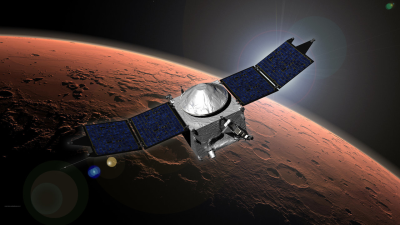
NASA’s Mars Atmosphere and Volatile EvolutioN (MAVEN) spacecraft has recently captured stunning ultraviolet images of Mars. These images provide scientists with valuable insights into the planet’s atmosphere, seasonal changes, and surface features. By utilizing ultraviolet wavelengths, MAVEN’s Imaging Ultraviolet Spectrograph (IUVS) instrument offers a unique perspective on Mars’ climate history and potential habitability.
MAVEN’s Ultraviolet Views of Mars:
- Equipped for Exploration: The MAVEN spacecraft carries the IUVS instrument, which obtained these global views of Mars.
- Beyond the Visible Spectrum: The IUVS instrument measures ultraviolet wavelengths ranging from 110 to 340 nanometers, providing data outside the visible spectrum.
- Colorized Representations: The images are colorized to enhance visibility and interpretation. Red, green, and blue represent different ultraviolet wavelength ranges.
- Interpreting the Colors: Atmospheric ozone appears purple, clouds and hazes appear white or blue, while the surface can appear tan or green, depending on the optimization of the image.
Martian Summer in Ultraviolet: First Image:
- Southern Hemisphere View: The first image, captured in July 2022, showcases Mars’ southern hemisphere during its summer season, when the planet is closest to the Sun. Mars experiences seasons due to the tilt of its rotational axis, similar to Earth.
- Prominent Features: The image reveals the haze-filled Argyre Basin depicted as pale pink and the cloud-filled deep canyons of Valles Marineris (colored tan).
- Shrinkage of Polar Ice Cap: The white southern polar ice cap is visible at the bottom, showing signs of shrinkage due to the relative warmth of summer.
- Hydrogen Loss Discovery: MAVEN’s observations during this period have led to the discovery of enhanced hydrogen loss from Mars, triggered by the warming and dust storms of southern summer.
- Mars at its Farthest: Second Image: The second image, taken in January 2023, showcases Mars’ northern hemisphere after it had reached the farthest point in its orbit from the Sun. The rapidly changing seasons in the north polar region result in an abundance of white clouds.
Exploring Mars:
- The Red Planet: Mars is the fourth planet from the Sun and the second smallest planet in our solar system. Its reddish color, attributed to iron oxide prevalent on its surface, has earned it the nickname “The Red Planet.”
- Harsh Environment: Mars is a dusty, cold, desert world with a thin atmosphere.
- Martian Origins: Mars derives its name from the Roman god of war.
The MAVEN Mission:
- Launch and Arrival: MAVEN was launched in November 2013 and entered Mars’ orbit in September 2014.
- Scientific Objectives: The mission aims to explore Mars’ upper atmosphere, ionosphere, and interactions with the Sun and solar wind, providing insights into the loss of the Martian atmosphere to space.
- Celebrating a Decade: The MAVEN team is preparing to celebrate the spacecraft’s 10th year at Mars in September 2024.
About NASA:
NASA, established in 1958, is an independent agency of the United States Federal Government. It succeeded the National Advisory Committee for Aeronautics (NACA) and is responsible for the civilian space program, aeronautics, and aerospace research.
Last Modified: February 20, 2024