
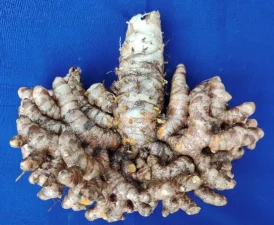
The Indian Institute of Spices Research (IISR) in Kozhikode revealed a new variety of turmeric named IISR Surya. This variety is tailored for the masala industry, featuring a light-coloured rhizome. It aims to meet modern market demands and enhance the quality of turmeric powder. The development of IISR Surya is advancement for farmers and the spice industry.
Development Process
IISR Surya was developed after extensive research lasting over a decade. Scientists D. Prasath, S. Arathi, N.K. Leela, S. Mukesh Sankar, and B. Sasikumar played crucial roles in its creation. The process involved clonal selection from turmeric germplasm maintained at the institute. This method ensures that the new variety retains desirable traits while improving yield and quality.
Features of IISR Surya
IISR Surya boasts several key features. It has a light-coloured rhizome that appeals to the powdering industry. The variety is high-yielding, offering a 20% to 30% increase in yield compared to existing local varieties. Researchers report that it can produce up to 41 tonnes per hectare. Additionally, the curcumin content ranges from 2% to 3%, comparable to other light-coloured turmeric varieties.
Impact on Farmers and Market
The introduction of IISR Surya is expected to benefit farmers. It addresses the shortage of high-quality turmeric in both local and export markets. Farmers specialising in turmeric production can adopt this variety to enhance their income. The new cultivar is recommended for cultivation in several state of Indias, including Kerala, Telangana, Odisha, Jharkhand, and Arunachal Pradesh.
Significance in the Spice Industry
IISR Surya represents a notable advancement in the spice industry. It aligns with the growing demand for high-quality turmeric powder. The development is part of a broader effort to improve agricultural practices and support farmers. By enhancing yield and quality, IISR Surya contributes to the sustainability of turmeric cultivation.
Future Prospects
The successful introduction of IISR Surya sets a precedent for future research in spice cultivation. Ongoing efforts may lead to the development of more varieties that meet market needs. The focus on sustainable practices and high-yield crops is crucial for the agricultural sector’s growth. Researchers continue to explore innovative solutions to enhance productivity.
Questions for UPSC:
- Discuss the significance of agricultural research in enhancing crop yields and quality in India.
- Critically examine the role of turmeric in the Indian economy and its impact on farmers’ livelihoods.
- What are the benefits of clonal selection in crop development? Explain with examples.
- What challenges do farmers face in the cultivation of spices? Discuss potential solutions to these challenges.
Answer Hints:
1. Discuss the significance of agricultural research in enhancing crop yields and quality in India.
- Agricultural research leads to the development of high-yielding and resilient crop varieties, improving food security.
- Research initiatives help in identifying pests and diseases, allowing for better management practices.
- Innovations in farming techniques enhance productivity and reduce resource wastage.
- Research supports sustainable practices, promoting environmental health and biodiversity.
- Government and private sector collaboration in research boosts funding and resource availability for agricultural advancements.
2. Critically examine the role of turmeric in the Indian economy and its impact on farmers’ livelihoods.
- Turmeric is cash crop, contributing to the income of millions of farmers in India.
- It is a vital ingredient in various industries, including food, cosmetics, and pharmaceuticals, driving economic growth.
- The demand for high-quality turmeric in global markets enhances export opportunities for farmers.
- Price fluctuations and market access challenges can impact farmers’ livelihoods .
- Government support programs and research initiatives can improve market stability and farmer income.
3. What are the benefits of clonal selection in crop development? Explain with examples.
- Clonal selection allows for the propagation of plants with desirable traits, ensuring consistency in quality.
- This method can lead to higher yields, as seen in the IISR Surya turmeric variety.
- Clonal selection helps in disease resistance, reducing losses and increasing profitability for farmers.
- It preserves genetic diversity within crops, enabling adaptation to changing environmental conditions.
- Examples include clonal selection in fruits like bananas and apples, which enhance taste and shelf life.
4. What challenges do farmers face in the cultivation of spices? Discuss potential solutions to these challenges.
- Farmers face issues such as pest infestations and diseases, which can severely impact crop yields.
- Market access and price volatility pose financial risks to spice growers.
- Climate change affects growing conditions, leading to inconsistent production levels.
- Limited access to modern agricultural practices and technologies can hinder productivity.
- Solutions include education and training programs, improved infrastructure, and government support for research and development.