
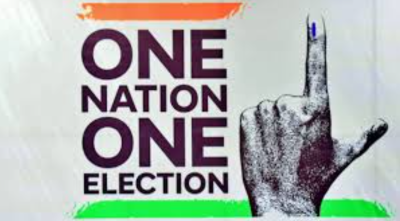
As Prime Minister Narendra Modi completes over twelve years in office, India has transformed into a fast-growing economy and a global leader, overcoming past challenges like policy paralysis and corruption. The next phase of reforms focuses on three key initiatives: One Nation, One Election to synchronize Lok Sabha and state elections for better governance efficiency; delimitation to ensure equal representation reflecting demographic changes; and the implementation of the Women’s Reservation Bill to enhance women’s political participation. These reforms aim to strengthen democratic governance, improve administrative focus, and accelerate India’s development trajectory towards becoming a developed nation by 2047.
Core Institutional Reforms
One Nation, One Election (Simultaneous Elections)
The initiative proposes a structural shift to align electoral cycles across the federal structure. It aims to hold concurrent elections for the Lok Sabha, State Legislative Assemblies, and local bodies. The Union Cabinet accepted the structural recommendations of the High-Level Committee on Simultaneous Elections to build a streamlined, predictable governance model. The Constitution (129th Amendment) Bill was introduced in Parliament to create the foundational framework for this synchronization.
Delimitation Exercises
Delimitation involves adjusting the boundaries of territorial constituencies to reflect demographic fluctuations fairly. This reallocation balances regional voting weight based on fresh census data. It ensures the constitutional mandate of equal voter representation is met across state lines, preventing growing populations from being politically underrepresented.
Women’s Reservation Implementation
The Nari Shakti Vandan Adhiniyam provides a 33% legislative reservation for women in the Lok Sabha and State Legislative Assemblies. This structural change brings gender parity to highest decision-making levels, transforming grassroot mobilization into concrete national legislative leadership.
Structural Dynamics of Simultaneous Elections
Rationale and Expected Outcomes
- Administrative Continuity: Frequent elections trigger the Model Code of Conduct regularly, causing extended pauses in policy rollouts and development projects. Synchronized polls eliminate these continuous governance bottlenecks.
- Fiscal Optimization: Operating disconnected polling exercises creates massive public expenditures. A unified mechanism drops security, administrative, and logistical operational costs significantly.
- Economic Boost: Projections indicate that the consolidation of the poll machinery could yield national savings up to ₹7 lakh crore and provide an estimated 1.6% boost to the National Gross Domestic Product (GDP).
Constitutional Amendments Required
Implementing simultaneous polls demands adjustments across crucial constitutional provisions without violating the basic structure.
| Affected Provision | Constitutional Subject Matter |
| Article 83 | Fixed duration and tenure of the Houses of Parliament. |
| Article 85 | Dissolution protocols of the Lok Sabha by the President. |
| Article 172 | Fixed duration and terms of State Legislative Assemblies. |
| Article 174 | Dissolution protocols of State Assemblies by Governors. |
| Article 356 | Provisions concerning failure of constitutional machinery in states. |
Handling Premature Dissolution
The reform sets out explicit guidelines if a hung house occurs or a government falls prematurely:
- Unexpired Term Elections: If the Lok Sabha or a state assembly dissolves prior to its five-year tenure, fresh elections are conducted solely for the remainder of the active five-year cycle.
- Cycle Preservation: This mechanism ensures that mid-term local political changes do not alter or disrupt the fixed national electoral timeline.
IASPOINT Booster Facts for UPSC
- Historical Precedent: India conducted simultaneous elections during the first four general election cycles in 1951-52, 1957, 1962, and 1967 before premature assembly dissolutions broke the pattern.
- Kovind Committee Panel: The High-Level Committee on Simultaneous Elections was established under the chairmanship of former President Ram Nath Kovind.
- Current Legislative Progress: The Constitution (One Hundred and Twenty-Ninth Amendment) Bill, 2024, along with the Union Territories Laws (Amendment) Bill, 2024, stands referred to a 39-member Joint Parliamentary Committee chaired by PP Chaudhary.
- The 100-Day Local Body Window: The proposed framework mandates that local body elections (Panchayats and Municipalities) must be executed within 100 days of completing the Lok Sabha and State Assembly polls.
- Common Electoral Roll: The framework proposes amending Article 325 to empower the Election Commission of India to manage a unified single voter list in coordination with State Election Commissions, removing existing data redundancies.
- Global Precedents: Countries like South Africa (national and provincial), Sweden (national, regional, and local), and Indonesia (unified presidential and legislative) operate forms of synchronized polling.