
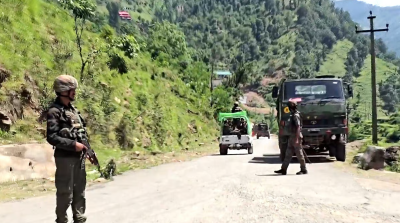
Operation Sheruwali is a joint counter-terrorism operation launched by the Indian Army, J&K Police, and intelligence agencies in the Rajouri district. The mission focuses on neutralising terror modules, destroying hideouts, and preventing infiltration across the Line of Control (LoC) in the Pir Panjal region.
Key Objectives and Tactical Measures
- Targeting Infrastructure: Locating and clearing natural cave hideouts and shelters within dense coniferous forests.
- Area Domination: Continuous day-and-night foot patrolling to deny operational space to insurgents in rugged terrain.
- Surveillance Technology: Deployment of thermal-imaging UAVs, ground-based electronic sensors, and night-vision radar to track heat signatures and movement.
- Inter-Agency Coordination: Real-time data integration between the Army, RAW, IB, and the J&K Police’s Special Operations Group (SOG).
Security and Geographical Context
- Terrain Challenges: The Pir Panjal range features deep gorges and dense canopy, which restricts aerial surveillance and necessitates physical tracking.
- Operational Command: The White Knight Corps (16 Corps), headquartered at Nagrota, oversees the sector south of the Pir Panjal, while the Chinar Corps (15 Corps) manages the Kashmir Valley.
- Strategic Location: Proximity to the LoC allows for rapid infiltration and retreat, making the area a high-priority security zone.
IASPOINT Booster Facts
- White Knight Corps: Formed on 1 June 1972, it is the Indian Army’s largest operational corps, responsible for borders south of the Pir Panjal.
- Line of Control (LoC): Re-designated from the Ceasefire Line following the Shimla Agreement (1972).
- Historic Precedent: Operation Sarp Vinash (2003) in the Hilkaka area remains a landmark success in dismantling large-scale terrorist networks in the region.
- Key Passes: The region includes the Haji Pir, Pir Panjal, and Banihal passes, which have historically served as critical transit routes.