
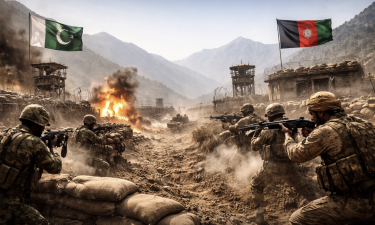
Recent tensions between Pakistan and Afghanistan have escalated into what Pakistan’s defence minister terms an “open war”. The conflict intensified after cross-border strikes by Afghan forces and retaliatory operations by Pakistan along the Durand Line. The situation has drawn international concern and calls for diplomatic resolution.
Background of the Conflict
The Durand Line, a 2,611-kilometre border, remains disputed as Afghanistan does not formally recognise it. Pakistan launched Operation Ghazab lil Haq, claiming to have killed 133 Taliban fighters in response to alleged Afghan attacks. The conflict reflects longstanding tensions involving the Tehreek-e-Taliban Pakistan (TTP) and border security issues. Civilian casualties have been reported, worsening humanitarian concerns.
India’s Position and Regional Reactions
India has condemned Pakistan’s airstrikes on Afghan territory, denoting civilian casualties during Ramadan. India supports Afghanistan’s sovereignty and territorial integrity. It accuses Pakistan of using cross-border terrorism to mask internal failures. Meanwhile, Turkey and Saudi Arabia have emphasised the need for peace and stability in the region through diplomatic engagement. Pakistan’s leadership has sought support from these allies amid the crisis.
Global Diplomatic Responses
China and Russia have urged both Pakistan and Afghanistan to exercise restraint and resolve disputes diplomatically. They brought into light the risks of armed clashes involving regular forces and heavy weaponry. Russia called for an immediate ceasefire and return to dialogue. Iran offered to mediate talks and stressed the importance of neighbourly relations during the holy month of Ramadan to reduce tensions.
Implications for Regional Stability
The conflict threatens to destabilise South and Central Asia. It risks expanding militant violence and worsening humanitarian crises. The involvement of multiple countries underlines the geopolitical complexity. The Durand Line dispute remains a core challenge. Sustained diplomatic efforts are essential to prevent further escalation and protect civilian lives.
Topics for Prelims:
Durand Line
- Established in 1893 between British India and Afghanistan.
- Length – approximately 2,611 kilometres.
- Not recognised by Afghanistan as an official border.
- Source of recurring disputes between Pakistan and Afghanistan.
- Divides Pashtun tribal areas across both countries.
Tehreek-e-Taliban Pakistan (TTP)
- Militant group operating mainly in Pakistan’s tribal areas.
- Opposes Pakistani state authority and conducts cross-border attacks.
- Linked to Afghanistan’s Taliban but distinct in leadership.
- Target of Pakistan’s military operations including Operation Ghazab lil Haq.
- Designated as a terrorist organisation by Pakistan and others.
Ramadan
- Islamic holy month of fasting and spiritual reflection.
- Observed by Muslims worldwide including Pakistan and Afghanistan.
- Period emphasises peace, self-discipline, and unity.
- Conflict during Ramadan draws criticism for harming civilians.
- Used diplomatically as a call for ceasefire and dialogue.
Questions for UPSC:
- Critically analyse the impact of unresolved border disputes like the Durand Line on regional security and bilateral relations in South Asia.
- Explain the role of non-state militant groups such as Tehreek-e-Taliban Pakistan (TTP) in exacerbating cross-border conflicts and their implications for counter-terrorism strategies.
- With suitable examples, comment on the importance of religious and cultural observances like Ramadan in influencing diplomatic efforts during conflicts in Muslim-majority regions.
- What are the challenges and opportunities in multilateral diplomacy involving countries like China, Russia, and Iran in resolving South Asian conflicts? Discuss with reference to the Pakistan-Afghanistan border tensions.
Answer Hints:
1. Critically analyse the impact of unresolved border disputes like the Durand Line on regional security and bilateral relations in South Asia.
- The Durand Line, established in 1893, is not recognised by Afghanistan, causing persistent sovereignty disputes.
- Unresolved borders fuel mistrust and frequent cross-border skirmishes between Pakistan and Afghanistan.
- Border disputes hinder effective border management, allowing militant groups to exploit porous areas.
- They complicate bilateral relations, limiting cooperation on trade, security, and counter-terrorism.
- Regional security is threatened as conflicts can escalate into broader military confrontations.
- Such disputes also affect the stability of South Asia by involving external powers and impacting refugee flows.
2. Explain the role of non-state militant groups such as Tehreek-e-Taliban Pakistan (TTP) in exacerbating cross-border conflicts and their implications for counter-terrorism strategies.
- TTP operates in Pakistan’s tribal areas and conducts cross-border attacks into Afghanistan and Pakistan.
- They challenge state authority, provoking military retaliation and escalating tensions between countries.
- TTP’s presence complicates peace efforts by blurring lines between state and non-state actors.
- Counter-terrorism strategies must address both military action and political solutions to insurgency.
- The group’s links with Afghan Taliban complicate diplomatic relations and regional security cooperation.
- Effective counter-terrorism requires regional intelligence-sharing and coordinated border management.
3. With suitable examples, comment on the importance of religious and cultural observances like Ramadan in influencing diplomatic efforts during conflicts in Muslim-majority regions.
- Ramadan emphasizes peace, self-discipline, and unity, providing a moral framework for ceasefires and dialogue.
- Conflicts during Ramadan, such as Pakistan’s airstrikes causing civilian casualties, attract greater condemnation.
- Religious observances are used diplomatically to call for restraint and promote reconciliation.
- Iran’s offer to mediate during Ramadan marks the role of shared faith in facilitating dialogue.
- Respecting cultural norms during conflict can reduce civilian suffering and open communication channels.
- Diplomatic timing around religious months can enhance the legitimacy and acceptance of peace initiatives.
4. What are the challenges and opportunities in multilateral diplomacy involving countries like China, Russia, and Iran in resolving South Asian conflicts? Discuss with reference to the Pakistan-Afghanistan border tensions.
- Challenges include differing strategic interests and alliances, e.g., China’s close ties with both Pakistan and Afghanistan.
- Russia and China urge restraint and dialogue but have limited direct influence on militant groups like TTP.
- Iran’s cultural and religious proximity offers mediation opportunities, especially during Ramadan.
- Multilateral diplomacy can pool resources and pressure conflicting parties towards ceasefire and talks.
- Geopolitical rivalries may hinder consensus and delay conflict resolution.
- Effective diplomacy requires balancing regional stability with respect for sovereignty and non-interference principles.