
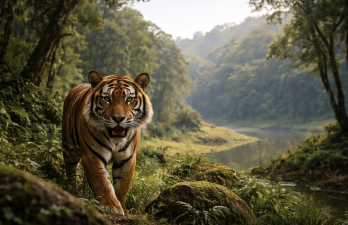
Periyar Tiger Reserve has entered Phase III of the All India Tiger Estimation (AITE) 2025–26, a decisive stage in India’s nationwide tiger population assessment. Beginning February 25, an intensive 30-day camera trapping exercise will unfold across the Reserve, reinforcing India’s scientific approach to monitoring its flagship species and strengthening landscape-level conservation.
What Phase III Tiger Monitoring Involves
4
Phase III represents the camera-trapping and photographic evidence stage of the All India Tiger Estimation exercise. In this phase:
- Tiger habitats are divided into uniform grids of 2 sq. km each.
- Two camera traps are installed in every grid.
- The dual-camera system captures both flanks of passing tigers.
This method is critical because each tiger’s stripe pattern is unique, much like a fingerprint. Capturing both flanks ensures accurate individual identification and reduces duplication errors in counting.
At Periyar, 470 grids have been created — 353 in the East Division and 117 in the West Division — with 940 camera traps deployed to ensure comprehensive spatial coverage. The exercise will run continuously for 30 days, from February 25 to March 27.
The Institutional Framework Behind Tiger Estimation
The All India Tiger Estimation is coordinated by the National Tiger Conservation Authority (NTCA) under the Ministry of Environment, Forest and Climate Change.
India’s tiger estimation follows a structured, multi-phase methodology:
- Phase I: Landscape-level habitat and prey assessment.
- Phase II: Sign surveys and occupancy analysis.
- Phase III: Intensive camera trapping and photographic capture-recapture.
- Phase IV: Statistical analysis and validation.
Data collected from reserves like Periyar Tiger Reserve will be compiled and analysed before being submitted to NTCA under national guidelines.
Why Periyar Matters in the Southern Landscape
4
Periyar is not an isolated habitat. It forms part of the larger Periyar–Agasthyamalai landscape in the Western Ghats, one of the world’s biodiversity hotspots.
It shares ecological connectivity with:
Such contiguous forest corridors are vital for maintaining genetic exchange between tiger populations. Connectivity strengthens metapopulation dynamics — a system in which smaller sub-populations remain viable through dispersal and gene flow.
Scientific Rigour and Capacity Building
Before deployment, frontline staff underwent structured training covering:
- Camera trap installation protocols.
- Site selection and positioning techniques.
- Routine maintenance procedures.
- Standardised data handling practices.
Standardisation is essential in large-scale ecological surveys. Uniform grid design and methodological consistency allow reliable comparison across states and landscapes, ensuring credibility of national estimates.
Why Tiger Estimation Is More Than Counting
India hosts over 70% of the world’s wild tigers. Periodic tiger estimation serves multiple purposes:
- Measures conservation success under Project Tiger.
- Identifies source and sink habitats.
- Guides corridor conservation and habitat management.
- Supports evidence-based policy and funding allocation.
Beyond numbers, the exercise reflects ecosystem health. As an apex predator, the tiger’s presence indicates balanced prey populations and intact habitats.
What to Note for Prelims?
- Periyar Tiger Reserve is located in Kerala within the Western Ghats.
- All India Tiger Estimation is conducted under the NTCA.
- Camera trapping uses stripe pattern recognition for individual identification.
- Tiger reserves function as source populations in landscape-level conservation.
What to Note for Mains?
- Discuss the importance of scientific monitoring in wildlife conservation.
- Examine the role of habitat connectivity in ensuring genetic viability of tigers.
- Analyse how tiger conservation reflects broader ecosystem management.
- Evaluate India’s model of large-scale wildlife population estimation.