
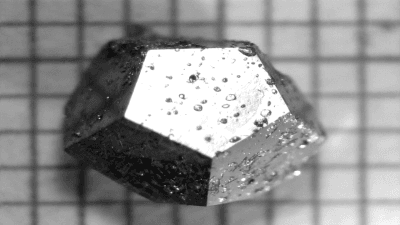
Quasicrystals were first discovered in 1982 by Israeli crystallographer Dan Shechtman. Since then, they have been the subject of intense research because of their unique atomic structure and physical properties. Quasicrystals have a unique pattern that is ordered in some directions, but not in others, and they exhibit non-crystallographic symmetries. Due to these unusual properties, they have the potential for use in various fields, including nanotechnology, energy storage, and electronics.
A new type of quasicrystal
In late 2021, a new type of quasicrystal was discovered in north-central Nebraska’s Sand Hills by a team of researchers from the University of Nebraska-Lincoln, Pennsylvania State University, and the University of Pennsylvania. The researchers found a quasicrystal with 12-fold symmetry, which is a property that had not been observed in quasicrystals before.
The discovery was made while studying fulgurites, which are hollow glass tubes that are formed when lightning strikes the ground. The researchers noticed a tiny metallic sphere that had formed inside the fulgurite. Upon closer examination, they discovered that the sphere was made of a new type of quasicrystal.
Quasicrystal is significant
The researchers believe that the quasicrystal was formed during an accidental electrical discharge that was triggered by a downed power line or a lightning strike. The electrical discharge caused the atoms in the soil to melt and rapidly cool, forming the quasicrystal. The discovery of this new quasicrystal is significant because it expands our understanding of the possible structures of quasicrystals and how they can be formed. This could lead to new applications in various fields, including materials science, physics, and chemistry.
Potential application of quasicrystals
One potential application of quasicrystals is in the development of new materials for energy storage. Quasicrystals have a high surface area, which makes them ideal for use in supercapacitors, a type of energy storage device that can charge and discharge rapidly. Quasicrystals also have a low resistance to electron flow, which is an important property for efficient energy storage.
Another potential application of quasicrystals is in the field of nanotechnology. The unique atomic structure of quasicrystals makes them ideal for use as templates for creating nanostructures. These nanostructures could be used in various applications, such as drug delivery systems or sensors.
In addition to energy storage and nanotechnology, quasicrystals also have potential applications in electronics. Quasicrystals can be used to create new types of semiconductors that have unique electrical properties. This could lead to the development of new electronic devices with improved performance.
Last Modified: February 20, 2024