
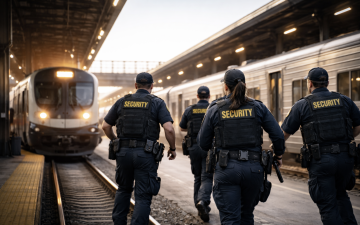
The 7th All India Conference of Government Railway Police (GRP) Chiefs concluded at Vigyan Bhawan, New Delhi, with a renewed focus on strengthening passenger and infrastructure security across the vast Indian Railways network. Convened by the [“Railway Protection Force”,”india railway security force”] (RPF), the conference was presided over by Director General Ms Sonali Mishra and attended by senior police officials from states and union territories.
Why Railway Security Requires Special Attention
Indian Railways is one of the world’s largest rail networks, carrying millions of passengers daily. Its open-access architecture, extensive geographical spread, and high passenger density make it uniquely vulnerable to:
- Organised crime.
- Narcotics trafficking.
- Stone pelting and vandalism.
- Sabotage and potential terror threats.
Given these emerging challenges, coordinated security planning between central and state agencies has become imperative.
RPF and GRP: Shared Responsibility
Railway security in India involves dual responsibility:
- The Railway Protection Force (RPF), under the Ministry of Railways, safeguards railway property and passenger areas.
- The Government Railway Police (GRP), under state police departments, handles law and order and crime investigation on railway premises.
The conference aimed to align operational strategies, improve intelligence sharing, and streamline procedures between the RPF and GRP.
Technology-Driven Security Architecture
A major theme of the conference was the adoption of advanced technologies to enhance surveillance and crime detection.
Key technological tools discussed include:
- Facial Recognition System (FRS)-enabled CCTV cameras.
- AI-based video analytics.
- Drone surveillance.
Such tools are expected to strengthen identification of habitual offenders, track suspicious movements, and enable proactive threat detection.
Roadmap to Combat Drug Trafficking
Given the rail network’s role as a transit corridor, drug trafficking was identified as a critical concern. A senior officer from the [“Narcotics Control Bureau”,”india anti narcotics agency”] (NCB) presented strategies focusing on:
- Proactive surveillance.
- Real-time intelligence sharing.
- Inter-agency coordination.
The conference formulated a roadmap to curb narcotics movement through railway routes, integrating intelligence networks and enforcement actions.
Preparedness Through Training and Community Outreach
To address sabotage, emergencies, and stone-pelting incidents, the conference recommended:
- Regular mock drills.
- Scenario-based training modules.
- Improved first-response mechanisms.
- Crowd control and evacuation preparedness.
Community engagement was also emphasised, particularly in vulnerable localities prone to stone-pelting. Awareness campaigns and deterrent legal measures were proposed to reduce recurring incidents.
Strengthening Institutional Coordination
The conference provided a common platform for state police leadership and railway authorities to share best practices and develop a coordinated programme of action.
Focus areas included:
- Improving infrastructure and facilities for GRP personnel.
- Standardising procedural frameworks.
- Enhancing operational synergy between central and state agencies.
Such alignment is crucial for building a resilient and responsive railway security system.
What to Note for Prelims?
- Railway Protection Force (RPF) functions under the Ministry of Railways.
- Government Railway Police (GRP) functions under state police.
- Key threats: narcotics trafficking, stone pelting, sabotage, organised crime.
- Technologies discussed: FRS-based CCTV, AI video analytics, drones.
- Narcotics Control Bureau (NCB) plays a role in drug enforcement.
What to Note for Mains?
- Discuss the security challenges faced by Indian Railways due to its open-access structure.
- Examine the role of technology in modernising internal security frameworks.
- Analyse the importance of Centre–State coordination in railway policing.
- Evaluate measures required to curb narcotics trafficking through transport corridors.