
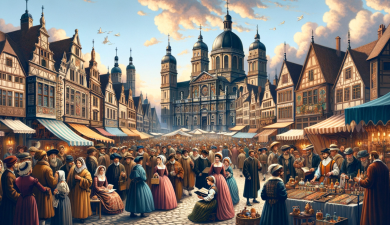
The Renaissance, a period that marked the transition from the Middle Ages to modernity, was a time of great intellectual, cultural, and artistic flourishing. This era, which originated in Florence in the 14th century and spread across Europe, was a rebirth of the classical knowledge and wisdom of Ancient Greece and Rome, and it led to unprecedented innovations that still resonate today.
For your examination, here is the list of questions which you must be able to answer:
What is meaning of Renaissance?
The term “Renaissance” means “rebirth,” reflecting the period’s revival of classical learning and wisdom after the so-called Dark Ages. This era was characterized by a renewed interest in the human experience, as well as in scientific, cultural, and artistic pursuits.
What is Humanism? Why it is called core of Renaissance Thinking?
Central to the Renaissance was humanism, a philosophy that emphasized the value and agency of human beings. Humanists studied the classics to learn what they revealed about human nature and emphasized a curriculum of humanities, including grammar, rhetoric, history, poetry, and moral philosophy.
What was the role of the Medici Family in Florence’s Rise?
The rise of Florence as the heart of the Renaissance is inextricably linked to the Medici family. Their patronage of the arts and generous support of scholars and artists was crucial for the blossoming of the era’s distinctive culture.
What were the key artistic innovations in the Early Renaissance?
Early Renaissance art was marked by the use of perspective, a technique that allowed artists to represent three dimensions on flat surfaces realistically. This innovation gave paintings a more life-like appearance and created a sense of depth and space.
How Florence became the cradle of Renaissance Culture?
Florence, under the rule of the Medici, became the cradle of Renaissance culture. The city’s wealth and political stability provided a fertile ground for the development of arts and ideas that defined the era.
What was Influence of Classical Antiquity on Renaissance Art?
Renaissance art was heavily influenced by the classics. Artists sought inspiration from ancient Roman and Greek art, valuing symmetry, proportion, and perspective, which led to more naturalistic and human-centered artwork.
What were major high Renaissance Art and its masterpieces?
The High Renaissance, which spanned the late 15th and early 16th centuries, is often considered the zenith of Renaissance art. Masterpieces from this period, such as Leonardo’s “Mona Lisa,” Michelangelo’s “David,” and Raphael’s “School of Athens,” exhibit the era’s defining characteristics: balance, harmony, and a profound understanding of human anatomy.
What was contribution of Leonardo da Vinci – The Renaissance Polymath?
Leonardo da Vinci was the quintessential polymath, with contributions that spanned painting, sculpture, architecture, science, music, mathematics, engineering, literature, anatomy, geology, astronomy, botany, writing, history, and cartography. His curiosity and inventive imagination epitomized the spirit of the Renaissance.
What were contributions of Michelangelo in Renaissance?
Michelangelo’s work on the Sistine Chapel’s ceiling is one of the most renowned achievements of Renaissance art. His depiction of biblical scenes, particularly “The Creation of Adam,” reveals a deep understanding of human anatomy and a powerful expression of humanity’s relationship with God.
What were contributions of and the Sistine Chapel and the School of Athens?
Raphael’s “School of Athens” is a fresco that represents the gathering of the greatest minds of ancient Greece, reflecting the Renaissance’s glorification of classical philosophy. The painting is a testament to the era’s celebration of human potential and intellect.
What was Venetian School?
The Venetian School is celebrated for its use of vivid colors and mastery of light. Artists like Titian used color and light to create a more dramatic effect, resulting in paintings that were rich in emotion and atmospheric depth.
Who was Titian and what was his contribution to Venetian Renaissance?
Titian was a leading figure of the Venetian school and is known for his versatile painting style. His works are notable for their bold use of color and the sensuous approach to form.
Who were the key Northern Renaissance artists?
The Northern Renaissance saw artists like Albrecht Dürer bring Renaissance ideas north of the Alps. Dürer was known for his woodcuts and engravings, which spread Renaissance styles and ideas throughout Europe.
How did architecture evolve from the Gothic style to the Renaissance style?
Renaissance architecture moved away from the Gothic style’s complexity and verticality, favoring symmetry, proportion, and geometry, which were seen as a return to the values of classical antiquity.
What was contribution of Filippo Brunelleschi in Renaissance architecture?
Filippo Brunelleschi’s engineering of the Florence Cathedral’s dome was a feat of architecture that combined Gothic and classical elements, symbolizing the Renaissance’s innovative spirit.
How did Renaissance sculpture progress and evolve from Donatello to Michelangelo?
Renaissance sculpture evolved from the rigid and formal styles of the Middle Ages to a more naturalistic approach, as exemplified by the works of Donatello and Michelangelo, who produced lifelike and emotionally expressive sculptures.
How did Renaissance literature evolve?
Renaissance literature was marked by a departure from the strict religious confines of the Middle Ages and an embrace of humanist principles. Writers like Petrarch and Shakespeare explored human emotion and experience in their works.
What were key contribution and impacts of Printing Revolution on renaissance?
The invention of the printing press by Johannes Gutenberg in the mid-15th century revolutionized the dissemination of knowledge. Books became more accessible, spreading the ideas of the Renaissance far and wide.
How Renaissance Culture Spread Across Europe?
The spread of Renaissance culture was facilitated by the movement of artists and scholars across Europe, the rise of trade, and the advent of the printing press, which made the dissemination of ideas quicker and more widespread.
What was impact of Renaissance on Music and Birth of Opera?
Renaissance music was characterized by greater use of instrumentation, harmony, and exploration of themes outside of the church. This period also saw the birth of opera, a form of musical theater that combines music, drama, and sometimes dance.
Last Modified: February 20, 2024