The Doctrine of Basic Structure is a legal principle in Indian constitutional law. It asserts that certain fundamental features of the Constitution cannot be altered or destroyed. This doctrine emerged from the Kesavananda Bharati case in 1973. It protects democracy, federalism, and the rule of law. The Supreme Court of India upholds this doctrine to maintain the Constitution's integrity and core values.
Judicial review is the power of the judiciary to declare the laws of the legislature and the orders of the executive unconstitutional if it feels that such laws/orders...
Every written constitution is the result of certain times. As times change, new trends changing situations, problems arise, which bring to forth issues which necessitate newer solutions and...
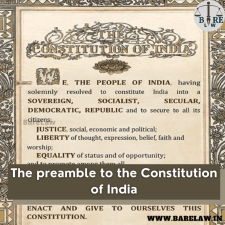
The American Constitution was the first to begin with a Preamble; India adopted this practice. The term "Preamble" refers to the introduction or preface to the Constitution. N....
The Chief Justice of India has declined to discuss the Basic Structure Doctrine during a public event, opting instead to express his views through judicial rulings. The Basic...
Paper ' I Political Theory and Indian Politics: Political Theory: meaning and approaches. Theories of the State: Liberal, Neoliberal, Marxist, Pluralist, Post-colonial and feminist. Justice: Conceptions of justice...
The concept of 'basic structure' in the Indian Constitution has its roots embedded in a historic judgement from 1973, the case of Kesavananda Bharati vs State of Kerala....
The Supreme Court of India recently ruled that restrictions imposed on individuals preventing their attendance or participation in court hearings due to the Covid-19 pandemic are legal. The...