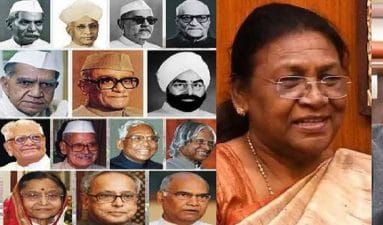
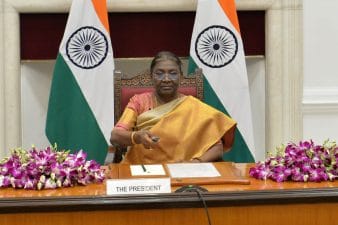
The President of India is elected by an electoral college. This college consists of elected members from both houses of Parliament and elected members of the Legislative Assemblies of States and Union territories. The election uses a system of proportional representation through a single transferable vote. The President serves a term of five years and can be re-elected. This process ensures a democratic selection.
The Election Commission as an autonomous, quasi-judicial and a constitutional body, was established for purposes of fair and free elections on January 25, 1950, under Article 324 of...
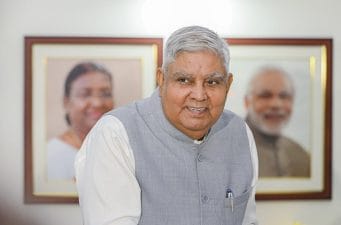
Article 63 of the Constitution of India provides that there shall be a Vice President of India. Articles 64 and 89(1) provides that the Vice President of India...
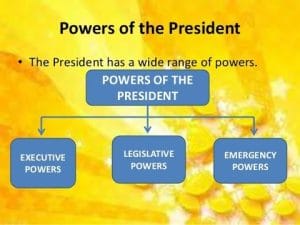
Some major executive powers and functions of the President are: 1. All executive actions of the Government of India are expressed to be taken in his name [Article...
Some of the major legislative and financial powers and functions of the President can be stated as: "The President summons or prorogues the Houses of Parliament and can...
A glance at the provisions relating to the powers, functions, duties and responsibilities of the President shows that it would be unfair if one takes the position that...
In a landmark election, 35-year-old businessman Daniel Noboa secured a historic victory, becoming the youngest president in Ecuador's history. He clinched the election with 52.3% of the vote,...
The Indian government recently established a committee to explore the feasibility of implementing the "one nation, one election" concept. The committee, led by former President Ram Nath Kovind...
The Indian government, under the leadership of former President Ram Nath Kovind, has initiated a committee to investigate the feasibility of implementing "One Nation, One Election." This concept...
Let me state my faith. As a Congressman wishing to'keep the Congress intact, I advise suspension of noncooperation, for I see that the nation is not ready for...