Fundamental Rights are essential guarantees for individuals in India. They protect citizens against discrimination and ensure equality. These rights include freedom of speech, religion, and assembly. They also safeguard against exploitation and provide the right to constitutional remedies. Enshrined in the Indian Constitution, these rights form the cornerstone of democracy. They empower citizens and uphold the rule of law in society.
The Supreme Court of India ruled that the right to vote and contest elections are not fundamental rights under the Constitution. The judgement was delivered on a petition...
The Constitution of India incorporates several features from other countries' constitutions. Notable borrowed elements include: Government of India Act, 1935: Federal scheme, emergency provisions, and the office of...
The Supreme Court of India plays important role in upholding the Constitution and protecting fundamental rights. Over the years, it has delivered numerous landmark judgments that have shaped...
The Supreme Court of India is the highest judicial forum and final court of appeal under the Constitution of India. Established on January 28, 1950, it replaced the...
The Constitution of India is a dynamic document that can be amended to address evolving societal needs. As of January 2025, there have been 106 amendments to the...
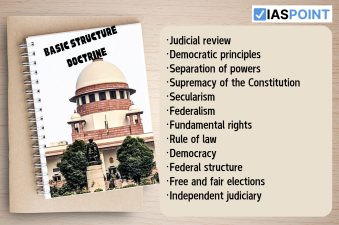
The Basic Structure Doctrine is a judicial principle in India. It asserts that certain fundamental features of the Constitution cannot be altered or destroyed by amendments. This doctrine...
Fundamental Rights are essential human rights enshrined in the Constitution of India. They are designed to ensure the dignity and liberty of individuals. These rights apply to all...