
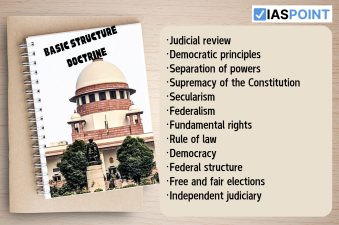
The Basic Structure Doctrine is a judicial principle in India. It asserts that certain fundamental features of the Constitution cannot be altered or destroyed by amendments. This doctrine emerged from landmark Supreme Court cases, particularly the Kesavananda Bharati case in 1973. The aim is to maintain the Constitution’s core values and principles.
Constitutional Framework
The Constitution of India empowers Parliament and State Legislatures to enact laws. However, this power is not absolute. The Supreme Court can invalidate laws that violate constitutional provisions. Article 368 outlines the procedure for constitutional amendments, but the Basic Structure Doctrine limits Parliament’s amending power.
Evolution of the Doctrine
The Basic Structure Doctrine has evolved through several key judicial decisions:
- Shankari Prasad Case (1951) – The Supreme Court upheld Parliament’s power to amend Fundamental Rights.
- Sajjan Singh Case (1965) – The Court reaffirmed Parliament’s authority to amend any part of the Constitution, including Fundamental Rights.
- Golaknath Case (1967) – The Court reversed its earlier stance, stating that Fundamental Rights could not be amended by Parliament.
- Kesavananda Bharati Case (1973) – This landmark ruling established the Basic Structure Doctrine, stating that Parliament cannot alter the Constitution’s basic structure.
Key Features of the Basic Structure
The Supreme Court has identified several key features that constitute the basic structure of the Constitution:
- Supremacy of the Constitution
- Democratic and republican form of government
- Federal character of the Constitution
- Secularism
- Separation of powers among the legislative, executive, and judiciary
- Judicial review
- Individual freedoms
Landmark Cases and Their Impact
Several cases have shaped the Basic Structure Doctrine:
Kesavananda Bharati Case (1973)
This case is very important in defining the Basic Structure Doctrine. The Supreme Court ruled that while Parliament has the power to amend the Constitution, it cannot alter its basic structure. This case set the foundation for subsequent interpretations of constitutional amendments.
Indira Gandhi v. Raj Narain (1975)
In this case, the Court struck down an amendment that sought to protect Indira Gandhi’s election from judicial scrutiny. The judgement reinforced the Basic Structure Doctrine by asserting that amendments cannot undermine free and fair elections.
Minerva Mills Case (1980)
The Supreme Court invalidated provisions of the 42nd Amendment that attempted to limit judicial review. The Court emphasised that a limited amending power is itself a basic feature of the Constitution.
Waman Rao Case (1981)
This case reiterated the Basic Structure Doctrine and distinguished between amendments made before and after the Kesavananda Bharati judgement. The Court held that amendments post that date are subject to judicial review.
Components of the Basic Structure
The Supreme Court has consistently identified several components as part of the Basic Structure:
- Judicial review
- Democratic principles
- Separation of powers
- Supremacy of the Constitution
- Secularism
- Federalism
- Fundamental rights
- Rule of law
- Democracy
- Federal structure
- Free and fair elections
- Independent judiciary
Judicial Review and Its Significance
Judicial review is important aspect of the Basic Structure Doctrine. It allows the judiciary to evaluate the constitutionality of legislative actions. This mechanism ensures that laws passed by Parliament do not violate the Constitution’s fundamental principles.
Recent Developments
The Basic Structure Doctrine remains relevant in contemporary judicial discourse. Recent cases continue to affirm its significance. The Supreme Court has reiterated the importance of protecting the Constitution’s core values against arbitrary amendments.
Last Modified: January 11, 2024