The political structure refers to the framework of governance within a state. It includes institutions, processes, and relationships that define how power is distributed and exercised. In India, this structure is shaped by its Constitution. It encompasses the executive, legislature, and judiciary. Each branch has distinct functions and powers. This system ensures checks and balances, promoting democratic governance and accountability.
In a landmark decision, the Supreme Court of India ruled against Tamil Nadu Governor R N Ravi's decision to withhold assent to ten pending Bills. The Court deemed...
The Union Ministry of Home Affairs (MHA) introduced the Immigration and Foreigners Bill. This legislation aims to consolidate and modernise the laws governing immigration and the status of...
Federalism is a governance structure where power is shared between a central authority and regional governments. It aims to balance independence and cooperation among different levels of government....
The State Legislature in India typically consists of the Governor and the Legislative Assembly, known as the Vidhan Sabha. This structure is referred to as a unicameral legislature....
The State Council of Ministers (CoM) is the executive authority in states of India. The CoM operates under the guidance of the Chief Minister and is responsible for...
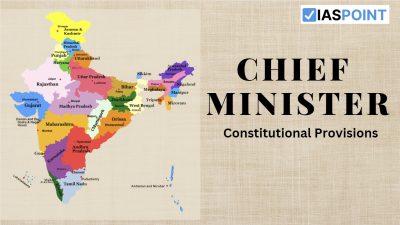
The Chief Minister (CM) is the real head of the state government in India. Unlike the Governor, who serves as the nominal executive, the CM is the real...
Cabinet Committees are essential components of India's governance structure. They consist of senior ministers and are chaired by the Prime Minister. These committees facilitate focused discussions on critical...
The Constitution of India is a dynamic document that can be amended to address evolving societal needs. As of January 2025, there have been 106 amendments to the...
The thesis of urban revival challenges the older 'Urban Decay' model, which suggested a total collapse of trade and city life between 600 CE and 1200 CE. Recent...
The early medieval period in India represents a structural departure from the centralized imperial bureaucracies of the Mauryan and Gupta periods. The polity was characterized by political fragmentation,...