
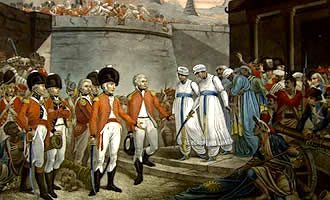

The 1857 Revolt, also known as the Sepoy Mutiny, was uprising against British rule in India. It marked a turning point in the relationship between the British Empire and its Indian subjects. The revolt began in May 1857 and culminated in 1858, involving various regions and groups across India.
Key Events of the Revolt
The revolt began with the discontent of sepoys in Meerut and quickly spread to Delhi, Kanpur, Jhansi, and Lucknow. Key events included:
- May 10, 1857 – The sepoys revolted in Meerut.
- September 20, 1857 – British forces recaptured Delhi.
- December 6, 1857 – Kanpur was retaken by Sir Colin Campbell.
- June 1858 – The Rani of Jhansi died in battle.
- April 1859 – Tantia Tope was captured and executed.
Causes of the Revolt
The revolt stemmed from multiple factors, including:
- Discontent among sepoys over pay and conditions.
- Religious and cultural insensitivity from the British.
- Economic exploitation through unfair taxation and land policies.
- Political grievances, including the annexation of state of Indias.
Territorial Limitations
The revolt did not achieve all-India participation. Key regions remained unaffected, particularly in the east, south, and west. The major uprisings occurred in northern and central India.
Loyalty of Indian Rulers
Many Indian rulers remained loyal to the British. Notable examples include:
- Scindia of Gwalior
- Holkar of Indore
- Various Sikh chieftains
These allegiances weakened the revolt’s impact.
Class Participation
Not all social classes participated in the revolt. Wealthy landlords and moneylenders often opposed it. The educated middle class viewed the uprising as regressive, preferring British modernization over feudalism.
Quality of Arms and Equipment
The rebels were poorly equipped compared to British forces. They primarily used swords and spears, while British troops had advanced firearms. This disparity impacted the revolt’s outcome.
Lack of Coordination
The revolt suffered from poor organisation and a lack of central leadership. Prominent leaders like Nana Saheb and Laxmibai were often outmatched by British commanders. The absence of a unified strategy hindered the rebellion.
Absence of Unified Ideology
The revolt lacked a cohesive ideology. Different groups had varied grievances, and there was no clear political vision. Modern nationalism had not yet emerged, complicating the rebels’ objectives.
Hindu-Muslim Unity
Despite the lack of a unified ideology, the revolt saw Hindu-Muslim cooperation. Bahadur Shah Zafar, a Muslim, was recognised as the emperor. This unity was crucial in the initial phases of the uprising.
Nature of the Revolt
The revolt’s nature is debated among historians. Some view it as a military mutiny, while others see it as a broader struggle against colonial rule. It involved various social classes but lacked a unified nationalistic goal.
British Response to the Revolt
The British response was marked by brutal military operations. They systematically targeted rebel leaders and employed harsh measures to suppress any remaining resistance. By 1859, British authority was firmly re-established.
Consequences of the Revolt
The revolt had consequences for India:
- The British government took direct control of India, ending the East India Company’s rule.
- Martial law was imposed in many regions.
- The Indian population faced severe repercussions, including economic burdens.
Historical Interpretations
Historians have various interpretations of the revolt:
- Some view it as the first war of independence.
- Others see it as a feudal uprising lacking national coherence.
- Marxist historians characterise it as a struggle against foreign and feudal oppression.
Legacy of the Revolt
The 1857 Revolt is remembered as event in Indian history. It laid the groundwork for future nationalist movements. It brought into light the need for unity among diverse groups against colonial rule.
Rebellious Leaders
Several leaders emerged during the revolt, including:
- Nana Saheb – A prominent figure in Kanpur.
- Laxmibai – The Rani of Jhansi, known for her bravery.
- Tantia Tope – A key military leader allied with Nana Saheb.
Their contributions remain in the narrative of resistance against British rule.
Impact on Indian Society
The revolt led to increased awareness of Indian nationalism. It sparked discussions about identity and unity among Indians. The events of 1857 served as a catalyst for future movements for independence.
British Policies Post-Revolt
Following the revolt, the British implemented policies to prevent future uprisings. They sought to divide and rule by exacerbating communal tensions. This strategy aimed to weaken potential coalitions against British rule.
Commemoration of the Revolt
The 1857 Revolt is commemorated in various forms. It is a subject of study in schools and universities. Memorials and museums also honour the leaders and events of this very important moment in Indian history.


