
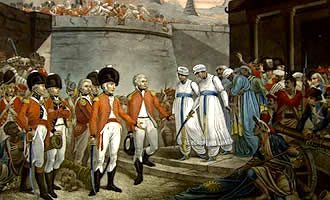

The British Indian Army was a key military force during British colonial rule in India. It played role in maintaining control and enforcing British interests. The army underwent several transformations from its inception in the 18th century until India’s independence in 1947.
Background of the British Indian Army
The British Indian Army evolved from the Presidency Armies of the British East India Company. These forces were established to protect trading interests in India. In 1748, Major-General Stringer Lawrence unified these forces, earning him the title “Father of the Indian Army.” By the mid-18th century, the East India Company maintained troops in three Presidencies – Bengal, Madras, and Bombay. Each presidency had regiments composed of European officers and Indian soldiers, known as “Native” troops.
Formation and Development
The military structure of British India was vital for the Company’s rule. Two main armed forces existed before the 1857 uprising – the Queen’s army and the Company’s army. The Queen’s army consisted of British soldiers, while the Company’s army included both British and Indian troops. The British often recruited from what they termed “martial races,” including Sikhs, Rajputs, and Gurkhas, while excluding other communities. The Bengal Army emerged as force, with its size increasing dramatically from 6,680 to 64,000 soldiers between 1763 and 1805. The British sought to maintain control and prevent rebellions by strategically recruiting soldiers from various regions.
Recruitment Practices
Recruitment practices were influenced by the British perception of different communities. The British classified certain groups as martial races, believing they were more loyal and suited for military service. This led to a biased recruitment strategy, favouring communities like the Sikhs, Gurkhas, and Rajputs, while neglecting others, such as South Indians and Bengalis. The British also created a structured caste system within the army. This ensured that only those deemed loyal to the Raj were enlisted. Consequently, the composition of the army reflected the British’s desire for control and stability in the region.
Army Structure and Ranks
The term “Sepoy” referred to Indian soldiers in the British Indian Army. Sepoys were primarily recruited from local communities in the Madras and Bombay presidencies. The command structure was hierarchical. At the top were European officers, followed by Indian non-commissioned officers. Each battalion comprised ten companies, each with about seventy sepoys. A subedar led each company, supported by jamadars and naiks. The European captain held the highest position in the basic command structure. The British maintained strict control over key positions and departments within the army.
Military Operations and Conflicts
The British Indian Army participated in numerous military operations. It fought in the Anglo-Mysore Wars, the Anglo-Sikh Wars, and the Indian Rebellion of 1857. These conflicts were crucial in shaping the army’s evolution and British policies in India. The Indian Rebellion of 1857 marked a turning point. It was uprising against British rule, driven by various grievances, including military practices. The aftermath led to direct British Crown control over India.
Changes Post-1857 Rebellion
Following the rebellion, the British restructured the army. They increased the proportion of British officers and imposed stricter recruitment policies. The ratio of British to Indian soldiers was adjusted to ensure greater control. The commissions of 1859 and 1879 mandated a one-third British presence in the army. This was a shift from the previous structure, aimed at preventing further insurrections. The British also maintained strict control over advanced military technology.
Role in World Wars
The British Indian Army played a vital role in both World War I and World War II. Many Indian soldiers were enlisted to fight alongside British forces. The army’s contributions were , with Indian troops participating in major battles across Europe, Africa, and Asia. The experience gained during these wars led to increased demands for independence. Soldiers returned home with new ideas and aspirations, contributing to the growing nationalist movement.
Legacy and Impact
The legacy of the British Indian Army is complex. It was instrumental in maintaining British control over India. However, it also contributed to the rise of nationalism and the push for independence. The army’s structure and recruitment policies reflected the British colonial mindset. The division of communities into martial races created lasting social divisions. The British Indian Army’s influence extended beyond military matters. It impacted governance, society, and culture in India. The army’s presence shaped the political landscape, leading to changes in the 20th century.
Transition to Independence
The British Indian Army ceased to exist in 1947 when India gained independence. The transition was marked by challenges, including communal violence and the partition of India. The Indian Army emerged from the remnants of the British Indian Army. It retained many traditions and structures but evolved into a national force representing an independent India.


