
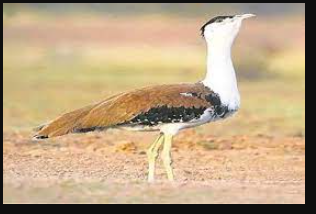
The Great Indian Bustard (Ardeotis nigriceps) is a large bird found in the grasslands of India and the adjoining regions of Pakistan. Once common across much of the Indian subcontinent, the species is currently endangered and faces the threat of local extinction in India.
Population Status and Decline
- Current population estimates: 150-200 individuals left in India as of 2024, with the majority found in Rajasthan. Population has declined by over 90% in the last 50 years.
- IUCN Red List status: Critically Endangered
- Identified as: One of the species for the recovery programme under the Integrated Development of Wildlife Habitats of the Ministry of Environment and Forests, Government of India
Key Threats Facing the Species
- Habitat loss due to agricultural expansion and mining
- Grasslands have been converted for agriculture, reducing available habitat
- Infrastructure projects like renewable energy farms in bustard habitats
- Hunting and poaching
- Still occurs albeit at a reduced level compared to earlier
- Collisions with power lines
- Electrocution and injuries from colliding with cables
- Disturbance from livestock grazing
- Reduces habitat quality and availability of food
- Climate change
- Rising temperatures could make their arid habitat even less hospitable
Conservation Actions Taken
- Project Great Indian Bustard started in 2011 to conserve remaining habitat
- Activities like planting local vegetation, installing fences, and working with communities
- State and national conservation breeding programs initiated
- Eggs collected from wild nests and chicks captive reared before being released
- Government protection
- Species protected under Wildlife Protection Act, 1972
- Some key habitats designated as special Protected Areas
- International cooperation
- MoU signed with the Government of Abu Dhabi to establish a breeding facility there
Despite these efforts, the population continues to decline indicating that current actions are likely inadequate. More urgent, coordinated and sustained efforts needed to prevent local extinction.
Key Population and Distribution Statistics
| Year | Population Estimate | Key Geographical Distribution |
| 1969 | 1300 individuals | Andhra Pradesh, Gujarat, Madhya Pradesh, Maharashtra, Karnataka, Rajasthan |
| 2015 | 150 individuals | Confined mostly to Rajasthan with a few individuals in Gujarat and Maharashtra |
| 2022 | <150 individuals | Rajasthan (>95% of population) |
Habitat Loss and Degradation
The single biggest threat to the survival of the Great Indian Bustard is the loss, degradation and fragmentation of its natural grassland habitat.
- Historical habitat was arid grasslands and deserts across western and central India. Rapid expansion of agriculture, industry and infrastructure has destroyed or altered these landscapes.
- Dry grasslands replaced by croplands growing cash crops like cotton, cumin seed, etc. Mining for minerals in key habitats is also a threat.
- Renewable energy expansion in the form of large solar and wind power farms in Rajasthan, Gujarat and Maharashtra threatens key bustard habitats that still remain.
- Livestock grazing and the introduction of invasive species also degrade and diminish habitat quality.
Recommendations for Habitat Conservation
- Protect remaining grassland areas from land use changes like farming, development projects, etc.
- Regenerate degraded habitats by removing invasive weeds and actively restoring native grass species.
- Incorporate bustard habitat requirements into land use planning and policies. Any projects in or around their habitats need to address and mitigate impact.
- Promote community participation in habitat conservation by providing appropriate incentives.
- Setup monitoring systems to track habitat health and bustard populations. Adaptive management protocols can then address issues in a timely manner.
Threats from Hunting and Poaching
Though illegal, hunting and poaching of the Great Indian Bustard continues to pose a threat to the remaining populations.
Reasons Why Poaching Persists
- Customary hunting of the bird by certain pastoralist communities
- Occasional hunting driven by superstition regarding supposed medicinal properties
- Opportunistic capture for meat since the bird is large
Anti-Poaching Actions and Recommendations
- Strengthen protection by forest departments in key reserves through increased patrols and monitoring. Set up dedicated bustard protection squads.
- Build awareness among communities on why continued hunting could lead to extinction in the wild. Counter superstitions with facts.
- Provide incentives and livelihood opportunities to communities dependent on the landscape to reduce incentive for poaching.
- Strict enforcement of wildlife protection laws with prosecution of offenders.
- Maintain captive populations as an insurance against extinction in the wild.
Threat from Power Lines and Recommendations
Collisions with power lines and electrocution on poles and towers poses a severe threat for the bustard including direct mortality and loss of habitat usage areas.
Key Reasons for Power Infrastructure Threat
- Low flight path of the bustards make collisions likely
- Poor visibility of power lines against backgrounds like the sky or sun increases collision chances
- Arm span of large males is close to power line separation – electrocution risk
- New renewable energy projects criss-cross remaining bustard habitats with transmission cables and towers
Recommendations to Prevent Electrocution and Collisions
- Careful planning of power infrastructure to avoid critical bustard zones
- Increased line spacing and marking of cables to improve visibility
- Use of underground cables instead of overhead lines in key areas
- Retrofitting modifications like pole caps and insulated conductors to reduce electrocution risk
There are technological solutions available to address this threat. Their prompt adoption could greatly reduce mortality rates of these endangered birds due to power lines.
The Way Forward
The progressive decline in Great Indian Bustard populations and distribution over the past five decades makes it clear that the species is on the brink of extinction in the wild in India. Targeted conservation efforts have had limited impact so far.
Last Modified: February 17, 2024