
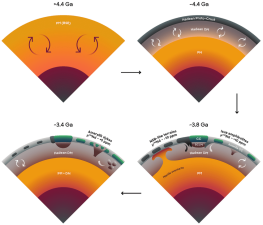
The Hadean protocrust refers to the Earth’s initial crust formed during the Hadean eon. This period lasted from the planet’s formation about 4.6 billion years ago until around 4 billion years ago. The surface of the Earth was highly volatile during this time. It experienced extreme heat due to frequent volcanic activity and constant bombardment by extraterrestrial bodies.
Formation of the Hadean Protocrust
Within the first 200 million years, the Earth’s surface was still partially molten. As the magma ocean cooled, the first fragments of crust began to solidify. This early crust was unstable and often flaky. Some sections would break apart while new areas formed. Over time, thicker regions of crust emerged, leading to the creation of the first continents.
Plate Tectonics and Movement
The Earth’s crust is divided into tectonic plates that float on the asthenosphere, a semi-fluid layer beneath. These plates began to move and interact with one another. They would sometimes collide, causing one plate to slide over another or dive beneath it. This movement is known as subduction.
Chemical Signatures in the Crust
The interactions of tectonic plates have left distinct chemical signatures in the Earth’s crust. Scientists have studied these signatures to understand the history of plate tectonics. Traditionally, it was believed that these signatures emerged after the onset of subduction.
Recent Research Findings
A recent study led by researchers from Macquarie University has challenged the long-held belief regarding the timing of these chemical signatures. The study suggests that these signatures were present in the Hadean protocrust itself, prior to the development of subduction. This finding raises questions about the early geological processes of the Earth.
Implications for Geology
If the findings from this study are validated, they could reshape our understanding of early Earth processes. The implications extend to theories of crust formation and the evolution of plate tectonics. Further research will be necessary to confirm these results and explore their broader significance in geology.
Questions for UPSC:
- Critically discuss the significance of chemical signatures in understanding geological history.
- Examine the role of volcanic activity in shaping the early Earth’s atmosphere.
- What are the implications of the Hadean protocrust findings for plate tectonics? Explain.
- Analyse the processes involved in the formation of the first continents on Earth.
Answer Hints:
1. Critically discuss the significance of chemical signatures in understanding geological history.
- Chemical signatures provide vital information about the composition and processes of Earth’s crust over time.
- They help identify the history of tectonic activities, including subduction and continental formation.
- Studying these signatures can reveal the conditions under which different geological formations occurred.
- They serve as markers for dating geological events and understanding the evolution of the planet.
- Recent findings suggest these signatures existed earlier than previously thought, challenging existing geological timelines.
2. Examine the role of volcanic activity in shaping the early Earth’s atmosphere.
- Volcanic eruptions released gases like water vapor, carbon dioxide, and sulfur dioxide, contributing to the early atmosphere.
- The heat from volcanic activity kept the surface molten, affecting crust formation and stability.
- Volcanoes played important role in creating a dynamic environment, influencing weather patterns and climate.
- They contributed to the formation of mineral resources and influenced the development of early life forms.
- Volcanic activity also led to the release of essential elements necessary for life, such as nitrogen and phosphorus.
3. What are the implications of the Hadean protocrust findings for plate tectonics? Explain.
- New findings suggest that chemical signatures associated with plate tectonics existed in the Hadean protocrust.
- This challenges the timeline regarding the onset of tectonic processes and subduction.
- It implies that early geological activity was more complex than previously understood.
- These findings may necessitate a reevaluation of the mechanisms driving tectonic movements in the early Earth.
- About these implications could refine models of Earth’s geological history and crust evolution.
4. Analyse the processes involved in the formation of the first continents on Earth.
- The first continents formed from the cooling and solidification of the Hadean protocrust as magma oceans cooled.
- Thicker sections of the crust emerged, leading to the stabilization of landmasses.
- Plate tectonics facilitated the movement and interaction of these crustal pieces, contributing to continental growth.
- Volcanic activity provided materials necessary for continental formation and affected landmass stability.
- Continental formation was a gradual process influenced by tectonic, volcanic, and erosion processes over millions of years.