
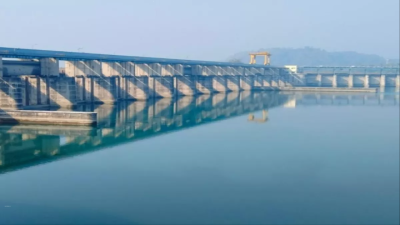
Amidst the recent flood situation in Delhi, a disagreement has arisen between the Delhi and Haryana governments regarding the release of water from the Hathnikund Barrage.
The Significance of the Hathnikund Barrage
The Hathnikund Barrage, located on the Haryana-UP border, plays a vital role in regulating the flow of the Yamuna River and managing water distribution among the riparian states. It was constructed to resolve the Yamuna water dispute among Himachal Pradesh, Haryana, Delhi, Uttar Pradesh, and Rajasthan. The barrage ensures equitable sharing of water resources and helps prevent conflicts over water distribution.
Water-Sharing Agreements and Allocation
- Under the Water Resources Ministry, an agreement was signed on May 12, 1994, to allocate water from the Yamuna River for drinking and irrigation purposes. The Hathnikund Barrage is instrumental in implementing this agreement. It ensures a minimum flow of 10 cumec (cubic meter per second) in the main Yamuna River.
- According to the agreement, the water from the Yamuna River is shared between Delhi, Haryana (through the Western Yamuna Canal), and Uttar Pradesh (through the Eastern Yamuna Canal) as per the agreed-upon allocation. These allocations are based on the respective water requirements of each state.
The Role of the Haryana Government
The Hathnikund Barrage is managed and operated by the Haryana government in adherence to the guidelines provided by the Central Water Commission (CWC). The Haryana government is responsible for regulating the release of water from the barrage and ensuring that the allocated amounts are distributed to the respective states as per the agreement.
Disagreement over Water Release
- Amidst the recent flood situation in Delhi, a disagreement has arisen between the Delhi and Haryana governments regarding the release of water from the Hathnikund Barrage. The Delhi government has requested Haryana to release water from Hathnikund to Delhi instead of Uttar Pradesh, citing the flood situation and the need for additional water supply to tackle the crisis.
- The Haryana government, on the other hand, has expressed concerns over diverting the water to Delhi instead of Uttar Pradesh, as per the agreed allocation. Haryana argues that diverting the water to Delhi could potentially disrupt the water supply to its own irrigation channels and affect agricultural activities in the state.
Finding a Resolution
- To resolve the disagreement, it is crucial for the concerned authorities to engage in constructive dialogue and seek an amicable solution. The priority should be to address the immediate flood situation in Delhi while considering the implications on water availability for Haryana and Uttar Pradesh.
- In such situations, it is important for the riparian states to work together and collaborate for the collective benefit of the region. The authorities should explore alternatives and temporary measures to manage the flood situation in Delhi without causing significant disruptions to the water-sharing agreements.
- Additionally, it is essential to strengthen coordination and communication mechanisms among the riparian states and establish robust mechanisms for managing water resources and addressing disputes in the future.