
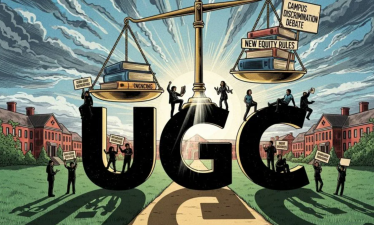
On January 29, the Supreme Court of India stayed the University Grants Commission’s new regulations on promoting equity in higher education, observing that they were “vague and capable of misuse”. The stay has reopened a larger debate on how caste discrimination on campuses should be defined, addressed, and remedied — and whether the new framework strengthens or weakens protections that have existed for over a decade.
What are the 2026 UGC equity regulations?
The University Grants Commission (Promotion of Equity in Higher Education Institutions) Regulations, 2026 were notified by the on January 13, 2026. They were intended to replace the 2012 anti-discrimination regulations and to provide a more structured mechanism to address inequity on campuses.
For the first time, the regulations explicitly defined “caste-based discrimination” as discrimination “only on the basis of caste or tribe” against members of the Scheduled Castes, Scheduled Tribes, and Other Backward Classes. They also offered a broad definition of “discrimination” as unfair or biased treatment — explicit or implicit — on grounds such as religion, race, caste, gender, place of birth, or disability.
New grievance redressal and accountability mechanisms
The 2026 framework proposed a multi-layered institutional structure to address complaints. Higher educational institutions were required to establish Equal Opportunity Centres, Equity Committees, and Equity Squads, along with Equity Ambassadors at the department or school level. Unlike the earlier regime, the new regulations also introduced institutional accountability, allowing penalties to be imposed on institutions that failed to comply.
Why were the regulations challenged as biased?
A section of students and faculty argued that the regulations were biased against those from “general” or “upper” castes. Their objection centred on three issues.
First, by defining caste-based discrimination only in relation to SC, ST, and OBC communities, critics argued that the regulations implicitly assumed that discrimination flows in only one direction. Second, the 2026 rules dropped a provision present in earlier drafts that dealt with action against “false complaints”, raising fears of misuse. Third, the functioning and powers of bodies such as Equity Squads were seen as insufficiently defined, creating scope for arbitrary action.
The Supreme Court’s role in shaping the regulations
The origins of the 2026 regulations lie in judicial intervention. They were framed under the supervision of a Supreme Court Bench hearing petitions filed in 2019 by the mothers of and , both of whom died by suicide after alleging caste-based discrimination in their institutions.
The petitioners argued that the 2012 UGC regulations were poorly implemented and ineffective in addressing what they described as “rampant caste discrimination” in higher education. During these proceedings, the UGC informed the Court that it had constituted an expert committee under Professor Shailesh N. Zala to revisit the 2012 framework, eventually leading to the 2026 regulations.
What did the 2012 regulations provide?
The 2012 regulations adopted a different approach. They did not separately define “caste-based discrimination” but instead provided a detailed definition of “discrimination”, covering denial of access to education, imposition of undignified conditions, and the maintenance of segregated academic or social spaces based on caste, creed, religion, language, gender, or disability.
They mandated the creation of Equal Opportunity Cells, SC/ST Cells, and the appointment of anti-discrimination officers. Crucially, the 2012 framework listed 25 specific acts and situations that would amount to discrimination in campus life — giving clarity to both complainants and institutions. However, these regulations did not explicitly extend protection to OBC students and lacked clear institutional penalties for non-compliance.
Criticism from within anti-discrimination circles
Opposition to the 2026 regulations did not come only from upper-caste groups. Several academics and social justice advocates argued that the new rules diluted existing safeguards rather than strengthening them.
Former UGC Chairperson Professor Sukhadeo Thorat pointed out that the regulations were unclear about their applicability to institutions such as IITs, IIMs, polytechnics, and nursing colleges. He also argued that the composition of Equity Committees should explicitly mandate representation for SC, ST, and OBC members. Jadavpur University Assistant Professor Subhajit Naskar similarly argued that removing the list of specific discriminatory acts had weakened enforcement and reduced clarity.
What happens now?
The Supreme Court has directed that challenges to the 2026 regulations be heard alongside the original petitions filed by the mothers of Rohith Vemula and Payal Tadvi. Until the matter is decided, the Court has asked the UGC to revert to the 2012 regulations.
The Bench has also framed broader legal questions on how discrimination should be defined, whether specificity is necessary in regulatory frameworks, and how institutional accountability can be ensured without violating principles of fairness. The next round of hearings is scheduled for March.
Why this debate matters
At stake is not just the wording of a regulation, but the balance between preventing caste discrimination and ensuring procedural fairness on campuses. The outcome will shape how equity, inclusion, and accountability are institutionalised in India’s higher education system — and whether regulatory clarity can coexist with social justice objectives.
What to note for Prelims?
- UGC notified Promotion of Equity Regulations in January 2026.
- Supreme Court stayed them on grounds of vagueness and misuse.
- 2012 regulations listed 25 specific acts of discrimination.
What to note for Mains?
- Judicial oversight in policy-making on social justice issues.
- Debate between specificity versus flexibility in regulatory design.
- Challenges of addressing caste discrimination in higher education institutions.