
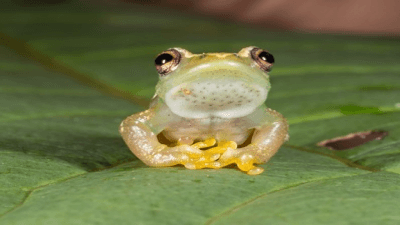
The discovery of a new species of frog has excited the scientific community as it has an uncommon characteristic of being completely silent. The Ukaguru spiny-throated reed frog (Hyperolius ukaguruensis) was found in the Ukaguru Mountains in Tanzania, and it does not croak, sing, or ribbit, unlike other frogs. This makes it one of the few frogs in the world that do not vocalize to other frogs.
New Species Discovery
In 2019, a team of international researchers led by Lucinda Lawson, a conservation biologist and assistant professor of research at the University of Cincinnati, conducted an amphibian search of the Ukaguru Mountains. They were on a mission to find the beautiful tree toad, Churamiti maridadi, but instead, they discovered a locally abundant population of reed frogs that was unknown to science. The team immediately realized that they had discovered something special, and a combination of genetic and genomic analyses confirmed that the frog was indeed distinct from other members of the Hyperolius genus.
Significance of the Discovery
The discovery of the Ukaguru spiny-throated reed frog is considered a significant win for conservation as it belongs to a group of frogs that is rare and has only a few species found in small populations, making them vulnerable to extinction. The new species joins a family of nearly 200 species in the genus Hyperolius, and its discovery could lead to the protection of the species and the preservation of the species-rich Ukaguru Mountains.
Male Frogs Do Not Call
The male frogs in the spiny-throated group do not call like other frogs, and the researchers believe that they might use the spines on their throat as something like Braille for species recognition. This group of frogs has only a few species, and finding a new member of this group is a major win for conservation. The researchers also found that the new species has unique body proportions, with smaller eyes in relation to its head than other spiny-throated reed frogs.
Conservation Concerns
The Mamiwa-Kisara North Forest Reserve, where the frog was found, is a T-shaped remnant forest with a lot of edge effects from people cutting firewood, and there are all sorts of pressures on the forest. The fast population growth in Tanzania means that the mountain forest habitats are under growing threats from people, and amphibians, in particular, are susceptible to human impacts, making them vulnerable to toxins or changes in water acidity.
Last Modified: February 20, 2024