
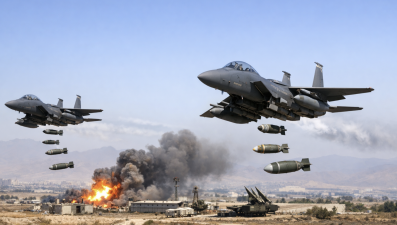
Recent developments in 2026 reveal change in the US military strategy against Iran. The US Defence Secretary announced a move from cautious long-range missile strikes to direct bombing using precision-guided gravity bombs. This marks a new phase in the ongoing US-Iran conflict.
Background of US-Iran Military Tactics
The US initially used standoff munitions like Tomahawk cruise missiles and LUCAS drones. These weapons strike from outside Iranian air defence range. The goal was to destroy radars and missile batteries while keeping pilots safe. These strikes maintained US air dominance without risking aircraft losses.
About Gravity Bombs
Gravity bombs are unpowered munitions dropped from aircraft. Their path is controlled by gravity and aerodynamics. Modern gravity bombs have been upgraded with JDAM kits that add GPS guidance and steerable fins. This technology allows precise targeting despite the bomb’s free-fall nature. Gravity bombs have been widely used in conflicts such as Iraq, Afghanistan, Syria, and by Israel in Gaza and Lebanon.
Conventional vs Nuclear Gravity Bombs
The bombs now deployed are conventional Mark 80 series. They carry chemical explosives and cost about $25,000 to $30,000 each with guidance kits. Nuclear gravity bombs exist but are costlier and require presidential authorisation. Nuclear bombs have yields measured in kilotons or megatons and are reserved for extreme scenarios.
Reasons for Tactical Shift
The shift reflects a balance between cost and risk. Missiles are expensive but safe for pilots. Gravity bombs are cheaper and allow mass bombing but require air supremacy to protect aircraft flying near targets. The US shift signals confidence in neutralising Iranian air defences. The Mark 80 bombs vary in size and target type, from light vehicles to deep bunkers.
Topics for Prelims:
Gravity Bombs
- Unpowered bombs dropped from aircraft.
- Modern versions use JDAM kits for precision.
- Used in Iraq, Afghanistan, Syria, Gaza, Lebanon.
- Conventional bombs carry chemical explosives.
- Nuclear variants require presidential approval.
US-Iran Conflict Military Strategy
- Initial use of standoff missiles and drones.
- Targeted radars and missile batteries.
- Shift to direct bombing with gravity bombs.
- Requires air supremacy for pilot safety.
- Marks a tactical pivot in 2026.
Mark 80 Bomb Series
- 500-pound Mk 82 for soft targets.
- 1,000-pound Mk 83 for reinforced structures.
- 2,000-pound Mk 84 for deep bunkers.
- Equipped with JDAM kits for accuracy.
- Used by various US aircraft types.
Questions for Mains:
- Critically analyse the advantages and risks of using precision-guided gravity bombs in modern warfare. Illustrate with examples from recent conflicts. [GS-III-Internal & External Security]
- Explain the concept of air supremacy and its significance in aerial combat strategies, especially in the context of the US-Iran conflict. [GS-III-Internal & External Security]
- With suitable examples, comment on the evolution of missile technology and its impact on international security and warfare tactics. [GS-II-International Relations]
- What are the ethical and strategic implications of deploying nuclear versus conventional weapons in conflict zones? Critically analyse with reference to global nuclear policies. [GS-IV-Ethics, Integrity and Aptitude]
Answer Hints:
1. Critically analyse the advantages and risks of using precision-guided gravity bombs in modern warfare. Illustrate with examples from recent conflicts. [GS-III-Internal & External Security]
- Advantages – Cost-effective compared to expensive missiles; allows high-volume bombardment.
- Precision guidance (JDAM kits) increases accuracy, reducing collateral damage.
- Requires air supremacy—risk to pilots if enemy air defences are active.
- Used effectively in Iraq, Afghanistan, Syria, and by Israel in Gaza and Lebanon.
- Risks include pilot exposure to anti-aircraft fire and potential escalation if used improperly.
- Shift from standoff munitions to gravity bombs signals confidence in neutralising enemy air defences.
2. Explain the concept of air supremacy and its significance in aerial combat strategies, especially in the context of the US-Iran conflict. [GS-III-Internal & External Security]
- Air supremacy means complete control of the airspace over a battlefield, denying enemy air operations.
- Essential for deploying gravity bombs safely, as aircraft must fly close to targets.
- US shift to gravity bombs indicates confidence in neutralising Iranian air defences.
- Without air supremacy, only standoff weapons (missiles, drones) can be used to avoid pilot risk.
- Air supremacy enables sustained, precise, and large-scale aerial bombardment.
- Critical for achieving tactical and strategic objectives in modern warfare.
3. With suitable examples, comment on the evolution of missile technology and its impact on international security and warfare tactics. [GS-II-International Relations]
- Early missiles were costly but allowed standoff attacks keeping pilots safe (e.g., Tomahawk cruise missile).
- Advancements include low-cost unmanned drones (LUCAS) enhancing surveillance and strike capabilities.
- Missile tech evolution has shifted warfare from direct dogfights to stand-off precision strikes.
- Increased missile range and accuracy affect global power projection and deterrence strategies.
- Missile proliferation raises risks of regional conflicts escalating and complicates arms control.
- US-Iran conflict illustrates balance between missile use and gravity bombs based on tactical needs.
4. What are the ethical and strategic implications of deploying nuclear versus conventional weapons in conflict zones? Critically analyse with reference to global nuclear policies. [GS-IV-Ethics, Integrity and Aptitude]
- Nuclear weapons cause mass destruction, long-term environmental and humanitarian harm.
- Use of nuclear weapons requires explicit presidential authorisation, reflecting global escalation risks.
- Conventional weapons are less destructive, more controllable, and preferred for limited conflicts.
- Ethically, nuclear deployment challenges principles of proportionality and discrimination in warfare.
- Global nuclear policies emphasize non-proliferation, deterrence, and prevention of nuclear war.
- Strategically, nuclear weapons serve as deterrents; their use risks catastrophic global consequences.