
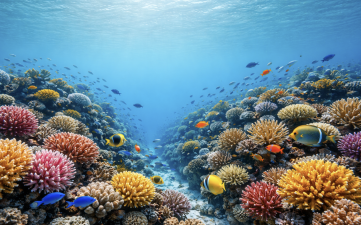
A decade-long artificial reef restoration of Vaan Island in the Gulf of Mannar has delivered socio-ecological benefits worth ₹61.67 crore — more than double its inflation-adjusted cost. The technical assessment by the Tamil Nadu Coastal Restoration Mission, in partnership with the Suganthi Devadason Marine Research Foundation and IIT Madras, estimates an adjusted Benefit-Cost Ratio (BCR) of 2.34. The findings underline how nature-based coastal restoration can generate tangible economic returns while reviving fragile marine ecosystems.
The Ecological Crisis That Triggered Intervention
Vaan Island is one of 21 uninhabited coral islands in the Gulf of Mannar. Between 1969 and 2015, the island lost nearly 92% of its area — shrinking from around 20 hectares to just 1.53 hectares.
The decline was driven by:
- Coral mining and reef degradation.
- Rising sea levels.
- Coastal erosion and sediment imbalance.
Without intervention, scientists warned that the island faced the risk of complete submergence — a fate already suffered by two islands in the region.
Artificial Reefs as a Nature-Based Solution
Beginning in 2015, researchers deployed 10,600 specially designed artificial reef modules around Vaan Island to arrest erosion and promote coral regeneration.
The results have been significant:
- Island area expanded from 1.53 hectares to over 2.3 hectares.
- Average of 81 coral colonies established per module.
- Reef-associated fish density increased from 106 to 875 individuals per hectare — an eight-fold rise.
- Preservation of 26 native coastal plant species.
Geomorphic monitoring indicates that the island’s physical stability has improved, demonstrating that even severe coastal loss can be reversed with sustained ecological engineering.
Economic Valuation of Ecosystem Services
The study places the total socio-ecological benefit at ₹61.67 crore against an inflation-adjusted cost of ₹26.37 crore (originally ₹17 crore in 2015).
Major contributors to economic value include:
- Mainland coastal protection – ₹28.57 crore (46% of total value).
- Regulating and supporting ecosystem services (sediment trapping, nutrient cycling) – ₹13 crore.
- Direct fisheries and epibenthic gains – ₹13.43 crore.
The project generated a positive Net Present Value (NPV) of ₹35.3 crore, reinforcing the economic viability of nature-based coastal adaptation.
Why Coastal Protection Matters for Tamil Nadu
Tamil Nadu has an extensive coastline vulnerable to cyclones, storm surges, and sea-level rise. Coral reefs function as natural breakwaters, absorbing wave energy and reducing erosion.
In this context, the Vaan Model demonstrates:
- Cost-effective climate adaptation.
- Enhanced fisheries productivity.
- Biodiversity conservation.
- Livelihood support for coastal communities.
The valuation translates ecological gains into economic evidence, strengthening the case for mainstreaming ecosystem-based adaptation.
Scaling the Vaan Model Across the Gulf
The success of Vaan Island has prompted the state to replicate the approach in other vulnerable locations. A ₹50 crore restoration project has commenced for Kariyachalli Island, with artificial reef deployment nearing completion.
Given that 20 islands in the Gulf of Mannar face erosion — and two have already submerged — scaling up reef-based interventions could become central to long-term coastal resilience planning.
What to Note for Prelims?
- Location and ecological importance of the Gulf of Mannar.
- Concept of artificial reefs and their ecological functions.
- Benefit-Cost Ratio (BCR) and Net Present Value (NPV).
- Nature-based solutions in climate adaptation.
What to Note for Mains?
- Discuss the role of ecosystem-based adaptation in coastal resilience.
- Examine the economic valuation of ecosystem services in public policy.
- Analyse the impact of coral reef degradation on fisheries and livelihoods.
- Evaluate whether nature-based solutions offer sustainable alternatives to hard coastal infrastructure.