
China and India began their post-independence economic journeys with broadly similar developmental challenges, but their trajectories diverged sharply after key policy shifts. China’s reforms under Deng Xiaoping in 1978 fundamentally altered its growth path, while India’s liberalisation came later in 1991. The widening gap in per capita income and industrial capacity since then raises a crucial policy question for India: what explains China’s sustained manufacturing-led surge, and what lessons are relevant for a democratic, federal India today?
From Central Planning to Market Dynamism in China
China’s 1978 reforms dismantled the rigidities of a centrally planned economy and replaced them with a pragmatic, outward-looking strategy. Foreign investment was actively courted, export-oriented manufacturing was prioritised, and local experimentation was encouraged. Importantly, the reforms were gradual but decisive, allowing markets to function while the state retained strategic control. This shift laid the foundation for China’s extraordinary industrial expansion.
Diverging Income Paths After Reform
Until the late 1970s, China’s per capita GDP was below India’s. This changed dramatically within a decade. By 1992, China’s per capita income had doubled India’s, and the gap kept widening even after India liberalised. By 2024, China’s per capita GDP was roughly five-and-a-half times that of India. The persistence of this divergence suggests structural differences rather than short-term policy shocks.
Manufacturing as the Engine of China’s Growth
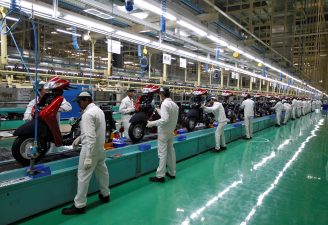
A central explanation lies in manufacturing. China’s share of global manufacturing output rose to nearly 30 per cent by 2023, while India’s remained around 3 per cent. China treated manufacturing not merely as a sector but as a national mission—integrating infrastructure, logistics, skills, finance, and exports into a single growth strategy. India, by contrast, experienced a services-led growth path, with manufacturing never achieving comparable scale or momentum.
Private Sector Emergence: Newcomers Versus Conglomerates
China’s private sector boom after 1978 was driven largely by new entrants. Most globally competitive Chinese firms were established after the mid-1990s, often by technocrats and entrepreneurs supported quietly by local governments. In India, however, a strong pre-existing private corporate sector meant that post-1991 reforms tended to favour established conglomerates. Newcomers found greater success in services—especially IT—rather than in large-scale manufacturing.
State Support and the Scale of Industrial Policy
The contrast is stark in public spending. India’s “” initiatives, including the PLI schemes, amount to roughly $36 billion. China’s “” drive involved public support close to $330 billion. This order-of-magnitude difference underscores how seriously China backed manufacturing, particularly new firms, with fiscal and financial resources.
Decentralisation and the Power of Local Governments
China’s local governments—especially city and provincial authorities—played a decisive role in nurturing entrepreneurs. They provided land, credit facilitation, infrastructure, and political protection, often before private enterprise was fully endorsed at the national level. In India, industrial support is far more centralised. This tends to advantage large, nationally connected firms over small and medium local enterprises. Empowering states and municipalities could rebalance this equation.
Research, Innovation, and the Knowledge Pipeline
Until the late 1990s, India and China spent similar shares of GDP on R&D. Thereafter, China sharply increased investment, reaching about 2.4 per cent of GDP by 2020, while India’s fell to around 0.64 per cent. China aligned R&D with industrial goals—solar, semiconductors, robotics, AI, and electric vehicles—and strengthened links between universities, research institutes, and industry. India’s recent initiatives, such as the “”, signal intent, but scale and integration remain key challenges.
Democracy, Constraints, and What India Can Still Do
India cannot replicate China’s authoritarian tools—such as controlled migration or selective regional favouritism. Yet democracy does not preclude an active developmental state. India can redirect support toward new manufacturing entrants, reduce regulatory friction, decentralise industrial promotion, and dramatically raise public and private R&D spending. Equally critical is improving the quality of school and higher education to sustain innovation-led growth.
What to Note for Prelims?
- China’s reforms began in 1978; India’s major liberalisation came in 1991.
- China’s share of global manufacturing: ~28–30%; India’s: ~3%.
- China’s R&D spending (~2.4% of GDP) far exceeds India’s (~0.64%).
- Role of local governments in China’s industrialisation.
What to Note for Mains?
- Analyse how manufacturing-led growth shaped China’s economic divergence from India.
- Discuss the role of state capacity, decentralisation, and industrial policy design.
- Evaluate limits and possibilities for adapting China’s lessons within India’s democratic framework.
- Link R&D, education quality, and industrial competitiveness.