
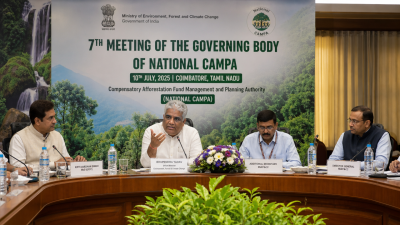
The 7th Governing Body meeting of National CAMPA was held on 10 July 2026 at CASFOS, Coimbatore, chaired by Union Minister Bhupendra Yadav; the authority reviewed performance and approved new schemes and digital tools.
Key Decisions
- Digital APO (FY 2026-27): Operationalised; States/UTs must submit Annual Plans online; integrated dashboards show fund utilisation and plantation performance.
- Harit‑SANKALP Portal: Developed with FAO‑India; provides QR‑code traceability for seed sources, nurseries and planting material for real‑time monitoring.
- Aastha Van Sanrakshan Yojana: Approved with a corpus of ₹3,000 crore (2026‑27 to 2030‑31) for conservation/restoration of ~15,000 sacred groves.
- MISHTI (Mangrove Initiative for Shoreline Habitats and Tangible Incomes): Revised outlay increased by ₹500 crore to a total of ₹600 crore; extended to 2029; ₹88.40 crore allocated for mangrove restoration across six States/UTs.
- Wildlife & restoration projects: Four new projects approved — River Dolphins Recovery Plan, Project Snow Leopard Phase‑II, Wild Water Buffalo, Indian Rhinoceros; continued support for Manipur’s Sangai; a landscape restoration scheme approved for National CAMPA funding.
- CoE and Portal: Centre of Excellence on Human–Wildlife Conflict inaugurated at WII‑SACON, Coimbatore; National Human–Wildlife Conflict Portal launched.
- Financial review: Governing Body reviewed NPV and Compensatory Afforestation progress; C&AG gave a “true and fair” certification for National Authority CAMPA accounts for FY 2024‑25.
IASPOINT Booster Facts
- Legal basis: National CAMPA is constituted under the Compensatory Afforestation Fund Act, 2016 to manage funds for compensatory afforestation and related activities.
- NPV: Net Present Value is charged on diversion of forest land and is remitted to CAMPA for restoration and conservation works.
- Use of funds: CAMPA funds finance afforestation, forest protection, wildlife conservation, eco‑restoration and infrastructure related to forest management.