
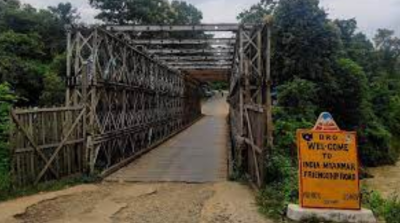
In a significant policy shift, India has decided to discontinue the Free Movement Regime or FMR that has governed travel between the two countries along their shared borders since 1995. Announcing the move, Home Minister Amit Shah cited national security implications arising from the uncontrolled flow of people as well as demographic changes in India’s northeastern states that the FMR contributed to.
The decision to end the Free Movement Regime (FMR) will have the following implications that require examination:
- Impact on border economies: The FMR facilitated over $2 billion in annual informal trade across towns like Moreh enabling interdependent micro-markets
- Effect on community ties: Visa-free crossings enabled thriving people-to-people ties and cultural interactions over 28 years since the 1995 treaty
- Local realities along the borders: Situations around demographic changes, ethnic unrest, refugee dynamics that likely necessitated evaluating the FMR on strategic grounds
- Strategic dimensions: Security issues like easing insurgent mobility and unchecked immigration leading to demographic imbalance cited behind the policy shift
- Migration triggers from Myanmar: Conflicts and persecution in Myanmar act as push factors for refugee exodus while economic aspirations pull migrants seeking livelihoods
Understanding Local Realities
- Geography and length: The two countries share over 1,600 km long border spanning 4 northeastern states – AP, Nagaland, Manipur and Mizoram
- Cultural intermixing: Centuries of migration mean extensive interrelations between border tribes like Nagas and Chins across porous frontiers
- Thriving local economies: Informal border trade enabled by FMR with minimal oversight sees over $2 billion in exchange annually around Moreh and Zowkhawtar
- Security challenges: Analysts argue Naga insurgent groups leverage people ties and unchecked mobility to sustain separatist struggles from Myanmarese soil for decades
Key Realities Along the India-Myanmar Border
| Parameter | Situation | Implication |
| Length of Land Border | 1,600 kms across 4 northeast states | Difficult to restrict movements across porous frontier |
| Ethnic Ties | Several tribes like Nagas share cross-border cultural links | Insurgents leverage community networks across border |
| Informal Border Trade | Estimated at $2 billion via Moreh and Zowkhawtar | Minimal regulation around goods and people flows |
| Security Threats | Naga militant groups operate camps in Myanmar | Unchecked mobility aids arms supply and anti-India activities |
Strategic Shifts on Border Security
- Cross-border insurgency: Though joint operations after 2015 attack dismantled some terror camps in Myanmar, new ethnic armed groups allying with Chinese outfits pose rising anti-India security threats
- Demographic imbalance: Unchecked immigration for decades has significantly altered compositions across northeastern districts bordering Myanmar
- Inter-community tensions: Influx of immigrants has reduced native tribes to minority status in violence-hit border belts
- Border security agenda: FMR termination aligns India’s priorities around strengthening perimeter control through fencing, sensors, drones etc.
- Tighter mobility regimes: Bangladesh border policy after 2015 Land Boundary Agreement also moved towards more stringent entry-exit norms
The above developments have precipitated the strategic shift ending the 28-year FMR model amidst aspirations to control demographic flux and external security threats along Myanmar borders.
Understanding Migration Triggers
While security risks justify relooking FMR to prevent destabilizing demographic shifts, the triggers behind uncontrolled immigration also need examination so mitigation conversations happen holistically factoring socioeconomic realities around fragile borders.
Key Migration Triggers from Myanmar into India’s Northeast
| Parameter | Situation | Implication |
| Economic Disparity | Per capita GDP 4 times higher in India | Pull factor for immigrants seeking livelihoods |
| Civil Conflicts | Long-running armed struggles displace Rohingyas, Chins etc | Refugee influx – over 100,000 sought shelter in Mizoram and Manipur |
| Ethnic Persecution | Military crackdown on minorities reported | Triggers exodus seeking asylum within cultural corridors |
| State Fragility | Myanmar ranks among world’s weakest states on stability | Spillover effects manifest across borders |
Nuanced Approach Needed
- Security imperatives justify India’s FMR termination but unilateral stance risks fleeting gains
- Tackling root socioeconomic deficits fuelling migration from Myanmar requires joint regional action
- Solutions warrant balancing stability concerns with humanitarian considerations around delicate border zones
- Centering affected communities is vital while handling complex mobility and access challenges
Way Forward
- Bilateral engagement plans factoring mutual security and migrant welfare priorities
- Grassroot border district development programs focusing livelihoods and ethnic harmony
- Exploring regulated migration channels easing pressures over long-term.