
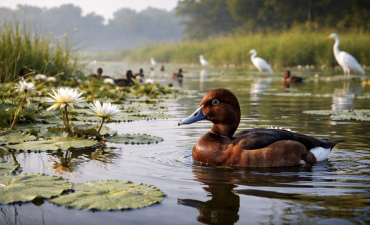
Amoor, a quiet village off the Tiruporur–Thirukazhukundram Road in Chengalpattu district, has unexpectedly turned into a birding hotspot. The reason is not a political motorcade, but a flock of migratory ducks — and among them, a rare visitor that has electrified Chennai’s birdwatching community: the Ferruginous Pochard.
What Was Spotted at Amoor Lake?
4
Over the past two weeks, Amoor lake has hosted a sizeable flock of Common Pochard (Aythya ferina), a migratory diving duck not commonly seen in large numbers around Chennai.
On February 14, three Chennai-based birders photographed what appeared to be an unusual individual among the flock. After images were shared on bird identification forums and verified by experienced observers, the bird was confirmed as a female Ferruginous Duck (Aythya nyroca), also known as the Ferruginous Pochard.
The record was subsequently uploaded to eBird, adding formal documentation to the sighting.
Why Is the Ferruginous Duck Significant?
The Ferruginous Duck is a winter migrant to parts of India but is rare in the Chennai Metropolitan Area. Its presence at Amoor marks only the second confirmed sighting in the region in recent years — the earlier being at Pallikaranai Marshland in 2023.
Globally, the species is listed as Near Threatened by the IUCN due to habitat loss, wetland degradation, and hunting pressures in parts of its range. Its appearance in an urban-peri-urban wetland highlights the ecological value of such waterbodies.
Identification Challenges: Common vs Ferruginous Pochard
Distinguishing between female Common Pochards and female Ferruginous Ducks can be tricky even for seasoned birders. Both belong to the genus Aythya and are diving ducks that often winter together.
Key identification features include:
- Ferruginous Duck (female): Warmer brown plumage, more uniform head colour, distinct pale eye, and cleaner white undertail.
- Common Pochard (female): Duller brown tones, greyish flanks, and less contrasting facial features.
There was also a possibility of hybridisation, as these two species are known to interbreed in overlapping habitats. However, bird identification experts ruled out hybrid characteristics in this case, confirming it as a pure Ferruginous Duck.
Wetlands Around Chennai: Why They Matter?
The sighting underscores the importance of small and medium-sized lakes in the Chengalpattu–Chennai region. Lakes like Amoor and the nearby Sirudavoor lake function as seasonal refuges for migratory waterfowl.
These wetlands provide:
- Feeding and resting grounds for migratory birds.
- Flood mitigation and groundwater recharge.
- Urban biodiversity support.
Rapid urbanisation, encroachments, and pollution have reduced many such waterbodies. Rare sightings serve as reminders of their ecological importance and the need for conservation.
Citizen Science and Modern Birding
The confirmation of the Ferruginous Duck highlights the role of digital platforms and citizen science. Birders shared photographs online, sought peer verification, and uploaded records to global databases.
Such documentation:
- Strengthens biodiversity mapping.
- Provides data for conservation planning.
- Enhances public engagement with nature.
What to Note for Prelims?
- Ferruginous Duck (Aythya nyroca) — Near Threatened species.
- Common Pochard (Aythya ferina) — migratory diving duck.
- Importance of wetlands like Pallikaranai Marshland.
- Concept of hybridisation in bird species.
What to Note for Mains?
- Role of urban and peri-urban wetlands in biodiversity conservation.
- Citizen science in environmental monitoring.
- Impact of habitat degradation on migratory bird species.
- Balancing urban expansion with wetland protection.