
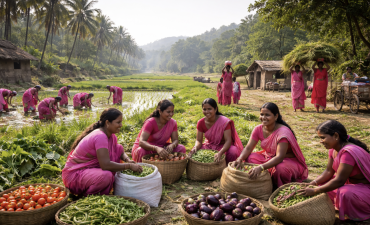
In a novel community-based conservation effort, the south division of Palamu Tiger Reserve (PTR) has launched the ‘Vanjeevi Didi’ initiative across 17 villages. The programme seeks to train educated rural women as ambassadors of forest and wildlife protection, blending conservation goals with social empowerment and grassroots governance.
What Is the ‘Vanjeevi Didi’ Programme?
Launched on February 17 in the Garu range, the initiative has identified 17 villages located in the hinterland of the reserve. From each village, 18 women — many of them graduates or currently pursuing higher education — have been selected.
Each Vanjeevi Didi receives a monthly incentive of ₹3,000 for an initial period of two months, subject to review. The project proposal has also been submitted to the state forest department for formal approval and funding support.
The idea is simple yet strategic: empower women within forest-fringe communities to act as moral and social persuaders against illegal logging, poaching, and habitat destruction.
Why Women at the Centre of Conservation?
4
PTR officials argue that those involved in forest offences often belong to local communities. By positioning women as conservation advocates within families, the administration hopes to reduce crimes through social persuasion rather than coercion.
Notably, women in more than a dozen families reportedly convinced their male relatives to surrender country-made firearms last year — an unprecedented step in curbing wildlife crime in the reserve.
This approach recognises women as:
- Influential decision-makers within households.
- Custodians of traditional ecological knowledge.
- Agents of behavioural change in close-knit rural societies.
Beyond Wildlife: Expanding Social Responsibilities
The Vanjeevi Didis are not limited to forest protection. Their mandate includes:
- Encouraging school enrolment by imparting primary-level teaching in villages.
- Spreading awareness about government employment schemes and development programmes.
- Acting as intermediaries between forest authorities and local families.
The model draws inspiration from self-help group frameworks such as Sakhi Mandals, which promote micro-banking and women’s financial inclusion. Similarly, just as para-legal volunteers bridge citizens with legal services authorities, Vanjeevi Didis are envisioned as a bridge between communities and forest governance.
Institutional and Ecological Context
Established in 1973 under Project Tiger, Palamu Tiger Reserve is one of India’s earliest tiger reserves. Located in Jharkhand, it forms part of the Chotanagpur plateau’s dry deciduous forest landscape.
However, the reserve has faced persistent challenges:
- Declining tiger numbers in recent decades.
- Human-wildlife conflict in fringe villages.
- Illegal felling and poaching.
- Socio-economic vulnerabilities in tribal-dominated areas.
In this context, the initiative aligns with India’s broader shift towards participatory forest management under frameworks such as Joint Forest Management (JFM) and eco-development committees.
Why This Model Matters for Conservation Policy?
The Vanjeevi Didi initiative reflects an important transition in environmental governance — from policing forests to co-managing them with local communities.
Its potential strengths include:
- Community ownership of conservation outcomes.
- Integration of gender empowerment with ecological sustainability.
- Reduction in enforcement costs through voluntary compliance.
- Improved trust between forest officials and residents.
However, long-term success will depend on sustained funding, institutional backing, and measurable ecological outcomes beyond the pilot phase.
What to Note for Prelims?
- Location of Palamu Tiger Reserve (Jharkhand; one of the first Project Tiger reserves).
- Concept of community-based conservation.
- Role of women’s self-help groups (SHGs) in rural governance.
- Link between forest conservation and livelihood schemes.
What to Note for Mains?
- Gender mainstreaming in environmental governance.
- Community participation versus top-down conservation models.
- Challenges of tiger conservation in socio-economically fragile regions.
- Role of behavioural change in preventing wildlife crime.