
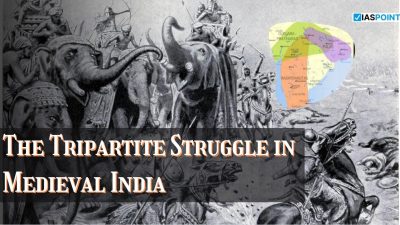
The Tripartite Struggle, also known as the Kannauj Triangle Wars, was conflict in northern India during the 8th and 9th centuries. It involved three major dynasties – the Palas, the Pratiharas, and the Rashtrakutas. This struggle was primarily for control of Kannauj, a city symbolising political power and economic prosperity.
Dynasties Involved
The Tripartite Struggle featured three prominent dynasties:
- Pala Empire (750-1161 CE)
- Founded by Gopala, elected by feudal lords.
- Dominated Bengal and Bihar.
- Notable ruler Dharmapala established Vikramshila University.
- Known for contributions to Buddhism.
- Gurjara-Pratihara Dynasty (730-1036 CE)
- Originated in the Mandor region.
- Expanded under Mihir Bhoja to Kashmir.
- Crucial in resisting Arab expansion.
- Earned the title “Ranahastina” (lords of war).
- Rashtrakuta Dynasty (753-982 CE)
- Rose to prominence in the Deccan under Dantidurga.
- Commissioned the Kailash temple at Ellora.
- Established dominance over Central and Deccan India.
Causes of the Struggle
Several factors contributed to the Tripartite Struggle:
- Significance of Kannauj: It was a political and cultural hub, strategically located on trade routes.
- Weak Rulers: Successive weak kings in Kannauj made it vulnerable to conquest.
- Desire for Supremacy: Each dynasty aimed to control northern India, seeking titles like “Uttarpathaswami.”
Phases of the Tripartite Struggle
The conflict can be divided into two main phases:
Phase I – The Initial Conflict (790 CE- 810 CE)
- The struggle began with a clash between Dharmapala and Vatsaraja at Prayaga.
- Vatsaraja’s victory forced Dharmapala to cede territories.
- Rashtrakuta king Dhruva defeated Vatsaraja but could not consolidate power due to southern conflicts.
Phase II – The Resurgence (810 CE – 836 CE)
- Dharmapala regained control of Kannauj and installed Chakrayudha as a vassal.
- Nagabhatta II of the Pratiharas invaded and defeated Dharmapala at Munger.
- Govinda III of the Rashtrakutas captured Kannauj but returned to the Deccan, allowing Pratiharas to regain control.
Historical Evidence
The Tripartite Struggle is documented through various sources:
- Inscriptions: Key records include the Ellora Record of Dantidurga and Gwalior Prashasti.
- Literary Works: Kalhana’s Rajatarangini has some details about this struggle.
- Foreign Accounts: Arab travellers like Al-Masaudi provided vital information about the period.
Consequences of the Struggle
The Tripartite Struggle resulted in deep changes:
- Consolidation of Power: The Pratihara dynasty emerged dominant, ruling for nearly three centuries.
- Cultural Renaissance: The period saw flourishing art and architecture, including distinct temple styles.
- Weakening of Empires: Continuous conflict led to resource depletion and instability.
- Administrative Developments: The struggle refined administrative systems, influenced by Gupta models.
Legacy of the Tripartite Struggle
The Tripartite Struggle had lasting impacts on Indian history:
- Political Landscape: The struggle set the stage for future power dynamics in northern India.
- Cultural Exchange: The competition among dynasties encourageed rich cultural interactions.
- Architectural Innovations: Unique temple designs and art forms developed during this period.
Notable Figures
Key rulers from the Tripartite Struggle include:
- Dharmapala: Pala king known for his patronage of Buddhism and education.
- Mihir Bhoja: A Pratihara ruler who expanded his empire.
- Govinda III: Rashtrakuta king who achieved military successes against both rivals.