
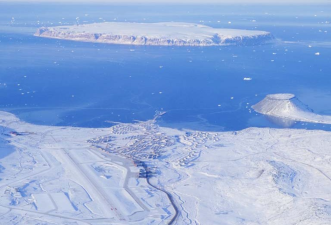
Greenland’s strategic importance has repeatedly overridden the rights, safety, and agency of its people. From Cold War nuclear accidents to contemporary geopolitical claims, the island has functioned less as a community with political voice and more as a strategic asset contested by powerful states. The 1968 Thule nuclear crash is not an isolated episode but part of a long continuum of control, secrecy, and coercion.
The 1968 Thule Nuclear Crash: What Happened?
On January 21, 1968, a B-52 bomber on a routine Strategic Air Command mission crashed near Thule Air Base in northwestern Greenland. A fire in the aircraft’s heating system forced the crew to eject. Upon impact, the plane’s four thermonuclear weapons did not trigger a nuclear explosion, but their conventional explosives detonated, dispersing plutonium-contaminated debris across more than five miles of ice.
Recovery efforts unfolded under extreme Arctic conditions—darkness, sub-zero temperatures, and ice storms. More than 10,000 cubic metres of radioactive snow and ice were excavated and shipped to Savannah River in the United States. One critical fissile component, known as the “spark plug,” was never recovered despite extensive underwater searches in North Star Bay.
Secrecy, Sovereignty, and the Danish Dilemma
The crash exposed a serious political contradiction. Denmark publicly maintained a no-nuclear policy in peacetime, yet had quietly allowed US nuclear deployments under tacit agreements dating back to 1957. Nuclear flights over Greenland and weapons storage at Thule had never been formally disclosed to the Danish government.
After the crash, then US Secretary of State Dean Rusk was compelled to negotiate with Danish officials to reconcile the incident with Denmark’s stated policy. Declassified documents reveal tension between written agreements and informal understandings, highlighting how Greenland’s status enabled ambiguity that favoured strategic convenience over transparency.
Greenland Before Thule: Colonial Control and Forced Relocation
The Thule incident sits atop a deeper colonial history. Danish rule over Greenland, extending from the eighteenth century into the twentieth, systematically subordinated Indigenous Inuit communities. In 1953, residents of Thule were forcibly relocated to Qaanaaq to make way for the US air base.
More than 130 villagers lost ancestral hunting grounds and traditional food systems. While there was no overt violence, the social consequences were severe: family networks fractured, livelihoods collapsed, and external authorities imposed new patterns of life. The relocation demonstrated how strategic priorities consistently outweighed Indigenous welfare.
Reproductive Control and Social Engineering
In the 1960s and 1970s, Danish authorities implemented a covert campaign of reproductive control over Greenlandic women and girls. Thousands were fitted with intrauterine devices or subjected to hormonal contraception without informed consent. Some were as young as twelve.
Estimates suggest around 4,500 women and girls—nearly half of Greenland’s fertile female population at the time—were affected. Many experienced long-term health complications, infertility, and psychological trauma. Although framed as population management and development, these measures amounted to systematic coercion. Formal apologies and compensation schemes came decades later, long after intergenerational damage had set in.
Why Greenland Matters Strategically
US interest in Greenland intensified during the early Cold War. The 1951 US–Denmark Defence Agreement allowed American bases and deployments with minimal restriction. Strategic planners viewed Greenland as vital for early-warning radar systems and power projection across the North Atlantic and Arctic.
In 1957, the US Joint Chiefs of Staff even proposed purchasing or leasing Greenland for 99 years—a proposal rejected by the State Department as diplomatically damaging. Yet in practice, the United States behaved as if strategic control were implicit. Nuclear-armed flights routinely passed over Greenland, and weapons were stored near Inuit settlements without consultation.
From Cold War Secrecy to Open Claims
What was once handled quietly is now increasingly explicit. Former US President publicly framed Greenland as indispensable to American national security, arguing that neither Denmark nor Greenland could prevent Russian or Chinese moves in the region. He asserted that NATO would be “far more formidable” with Greenland under US control and dismissed Greenlandic leaders who affirmed loyalty to Denmark.
These statements broke with diplomatic convention but not with historical practice. They reflect a long-standing pattern in which strategic imperatives override local governance and consent.
Limits of Resistance and the Weight of History
Danish and Greenlandic leaders have formally rejected American assertions, emphasising autonomy and existing agreements. However, power asymmetries are stark. Geography, alliance structures, and US military capacity constrain meaningful resistance. Historical records show that Greenlandic voices were marginal in decisions taken in 1957, 1968, and beyond—and remain so today.
The continuity is striking: colonial administration, forced relocation, environmental risk from nuclear deployments, and now open geopolitical contestation. Each phase reinforces the idea of Greenland as territory to be managed, not a society with agency.
What to Note for Prelims?
- 1968 Thule B-52 nuclear crash and its consequences.
- US–Denmark Defence Agreement (1951).
- Strategic importance of Greenland in Arctic security.
- Qaanaaq relocation and Indigenous rights issues.
What to Note for Mains?
- Intersection of geopolitics, colonial legacy, and Indigenous rights.
- Strategic ambiguity and sovereignty in alliance politics.
- Environmental and human costs of nuclear deployments.
- Contemporary Arctic geopolitics and great-power competition.