
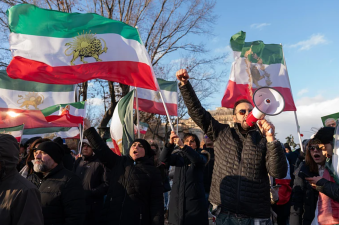
Iran is facing its most serious internal challenge since the Islamic Republic was established in 1979. The ongoing protests, driven primarily by economic collapse, have reopened fundamental questions about regime stability, external intervention, and the limits of coercive power in reshaping West Asia.
How the current crisis fits Iran’s protest history
Mass protests are not new to Iran. The 2009 Green Movement challenged electoral legitimacy; 2019 saw violent unrest linked to fuel price hikes; and the 2022–23 uprising followed the death of Mahsa Amini in police custody over alleged hijab violations. Each wave was crushed with force, with over 500 reportedly killed in 2022–23 alone. The current protests, however, differ in origin and scale. They are rooted less in social freedoms and more in economic despair, making them broader and potentially more destabilising.
Economic collapse as the trigger
The immediate catalyst is the collapse of the Iranian rial, which has driven food inflation beyond 70 per cent and sharply increased unemployment. Long-standing US-led sanctions on oil exports have slashed revenues and depleted foreign exchange reserves. This pressure has been compounded by the economic costs of recent military escalation with Israel and the US, including higher taxes imposed by the state. While casualty figures remain opaque, estimates suggest thousands have been killed and many more injured as protests spread.
Opposition voices and external encouragement
Reza Pahlavi, son of Iran’s former Shah and based in exile in the United States, has openly called on protesters to seize cities and overthrow the regime, promising a transition toward democracy. Tehran maintains that the unrest is being fuelled by external actors, particularly the US and Israel. This perception has hardened the regime’s resolve and framed the protests as a national security threat rather than a domestic grievance.
Why Iran matters so deeply to the US
For US President , the Iranian regime represents both an ideological adversary and a historical wound. Iran’s support for groups hostile to Israel, including Hamas, Hezbollah and the Houthis, and its backing of the Assad regime in Syria, place it at the centre of US–Israel security concerns. Beyond this, Iran was the site of one of America’s most humiliating episodes: the failure of Operation Eagle Claw in 1980 to rescue US embassy hostages, a legacy that still shapes American strategic thinking.
Military pressure without clear endgames
As protests intensified, Trump publicly encouraged demonstrators and quietly raised US force levels in West Asia, including repositioning a carrier group. Iran intermittently offered negotiations, which were accepted and then abandoned. While US military planners reportedly presented strike options, doubts persisted over whether airstrikes could actually produce regime change. Trump ultimately called off strikes at the last moment, officially citing Iranian assurances on halting executions, while quietly preparing for possible retaliation by relocating US personnel from regional bases.
Regional resistance to escalation
Key regional players, including Saudi Arabia, Qatar and Oman, urged restraint. Their concerns were pragmatic: Iranian retaliation could destabilise the Gulf, threaten oil infrastructure, and send global energy prices soaring. Saudi Arabia’s refusal to allow its airspace to be used for strikes against Iran was a significant signal. Israel, meanwhile, faces its own dilemma — retaliation could draw devastating missile strikes, while restraint risks domestic political backlash.
Why airstrikes rarely deliver regime change
History suggests that economic collapse and external pressure alone do not topple regimes. Venezuela and Cuba have endured prolonged economic failure so long as their militaries remained loyal. Iran presents even greater constraints: it is landlocked, heavily militarised, and dominated by the . Civilian casualties from US strikes could easily reverse public anger against Washington rather than Tehran.
The decisive factor: military loyalty
Regime change occurs only when security forces refuse to fire on their own population. This dynamic brought down Hosni Mubarak in Egypt, Muammar Gaddafi in Libya, and authoritarian regimes in Eastern Europe in 1989. Similar outcomes followed military defection in Bangladesh. In Iran, there is no credible evidence yet of a split within the IRGC or regular forces, making sudden collapse unlikely.
Why Gulf states fear regime change
Paradoxically, many Gulf monarchies prefer a sanctioned and contained Iran to a revolutionary transformation. A successful uprising could inspire a second Arab Spring, unsettling regional regimes. Economically, Iran’s isolation has kept oil prices around USD 60 by limiting supply, with China as its primary buyer. A pro-US Iran releasing oil into global markets could push prices toward USD 40, hurting oil-dependent economies — including US shale producers themselves.
Great power stakes: China and Russia
Iran’s alignment with China and Russia gives the crisis global significance. Regime change in Tehran would weaken Beijing’s access to discounted oil and reduce Moscow’s influence in West Asia. This could indirectly constrain China’s strategic flexibility, including in theatres like Taiwan or the India–China frontier. Yet neither China nor Russia appears willing to intervene decisively.
What Trump is really weighing
For Trump, the choice is not between action and inaction, but between uncertain gains and predictable risks. Military engagement could damage Iran’s economy further and pressure its leadership, but it may equally consolidate nationalist sentiment and destabilise the region. Any escalation would also undermine Trump’s self-image as a dealmaker and peace broker.
What to note for Prelims?
- Key protest movements in Iran since 1979.
- Role of sanctions in Iran’s economic crisis.
- Significance of the Islamic Revolutionary Guard Corps.
- Operation Eagle Claw (1980).
What to note for Mains?
- Limits of external intervention in regime change.
- Link between economic crises and political instability.
- Regional energy politics and global oil markets.
- Iran’s role in US–China–Russia strategic competition.