
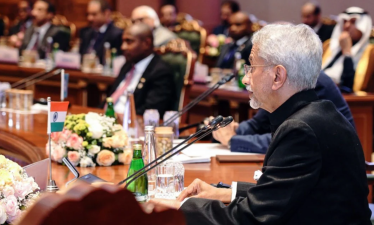
India’s hosting of the second India–Arab Foreign Ministers’ Meeting marks a significant moment in New Delhi’s West Asia diplomacy. Held a decade after the first such meeting in Bahrain, the interaction came amid heightened geopolitical churn — sharpening US–Iran tensions, visible strains between Saudi Arabia and the UAE, and renewed US-led attempts to reshape the Israel–Palestine peace process. Against this backdrop, the meeting and its outcome document, the Delhi Declaration, offer insights into how India and the Arab world are navigating an increasingly fragmented regional order.
Why the Timing of the Meeting Matters
The meeting brought together 22 members of the League of Arab States at a moment when multiple crises intersect. In the days leading up to the talks, India hosted UAE President Mohammed bin Zayed for a brief but unusually long visit, signalling New Delhi’s sensitivity to emerging tensions between Abu Dhabi and Riyadh. Almost simultaneously, India’s Deputy National Security Adviser travelled to Tehran amid a visible US military build-up around Iran, while New Delhi reaffirmed its support for Palestine during the visit of the Palestinian Foreign Minister.
These parallel engagements underline India’s stakes across competing power centres in West Asia — energy security, diaspora welfare, trade routes, and strategic connectivity — all of which could be destabilised by regional escalation.
The Delhi Declaration and the Politics of Sovereignty
A central theme of the Delhi Declaration is the emphasis on “sovereignty, unity and territorial integrity” of Sudan, Libya and Somalia, coupled with a rejection of external interference. This language is not incidental. All three countries sit at the heart of a quiet but consequential rift within the Middle East.
On one side stands a Saudi Arabia–led grouping that prioritises state sovereignty and political reconciliation. On the other is a UAE–Israel axis, backed by the United States, that has pursued more interventionist approaches in certain theatres. While these camps are not formally declared — the UAE remains an influential Arab League member — their competing strategies are visible on the ground.
Sudan, Libya and Somalia: Lines of Division
In Sudan, the UAE has been accused of backing the Rapid Support Forces, which have fought the Sudanese state since 2023 and announced a parallel government in 2025. In Libya, Abu Dhabi has long supported the Libyan National Army led by Khalifa Haftar, in opposition to the UN-recognised government in Tripoli. Saudi Arabia and other Arab League members, by contrast, have largely focused on mediation and reconciliation.
Somalia presents a different but related challenge. Israel is the only UN member to recognise the breakaway Republic of Somaliland, and the UAE’s decision to recognise Somaliland passports in 2025 put it at odds with most Arab states. By explicitly supporting the internationally recognised governments in Sudan, Libya and Somalia, India aligned itself firmly with the Arab League consensus.
Yemen, Red Sea Security and a Subtle Policy Shift
The Declaration’s explicit condemnation of Houthi attacks on Red Sea shipping marks a subtle shift in India’s recent diplomatic language. Over the past two years, New Delhi had avoided naming the Houthis directly, as they linked their actions to Israel’s war in Gaza. The new phrasing brings India closer to the Saudi position, which views the Houthis as a direct security threat.
Equally significant is the Declaration’s emphasis on Yemen’s unity. This mirrors Riyadh’s stance against the UAE-backed Southern Transitional Council, a secessionist group in southern Yemen, and reflects Saudi Arabia’s renewed military and political push to preserve Yemen’s territorial integrity.
Syria: Caution Over Engagement
On Syria, the Delhi Declaration remains notably restrained, limiting itself to appreciation of Damascus’s counter-terrorism efforts against the Islamic State. India’s engagement with post-Assad Syria, now led by Ahmed al-Sharaa, has remained cautious and bureaucratic. Diplomatic interactions continue, but without strong political endorsement, reflecting uncertainty over Syria’s future trajectory.
Israel–Palestine and the Silence on the Board of Peace
The Declaration avoids any reference to the Donald Trump–led Board of Peace, despite several Gulf states joining the initiative and India receiving an invitation. Instead, it reaffirms support for the Arab Peace Initiative of 2002, which offers recognition of Israel in return for a Palestinian state based on pre-1967 borders.
This choice is telling. While both India and Arab states welcome efforts to end violence in Gaza, they remain cautious about endorsing new frameworks that could dilute Palestinian sovereignty. Support for outcomes of the 2025 Sharm el-Sheikh summit further reinforces this preference for established diplomatic tracks.
Iran, Strategic Silence and Indian Constraints
Perhaps the most consequential omission in the Declaration is the absence of any reference to the US military build-up around Iran. This silence reflects a shared preference for bilateral diplomacy. Saudi Arabia and other Arab League states are quietly discouraging US military action, while India is seeking to preserve its relationship with Tehran amid sanctions pressure.
India’s vulnerability is evident in the absence of budgetary allocation for the Chabahar Port in the 2026–27 budget, despite a 10-year operating agreement signed in 2024. The episode highlights the constraints India faces in balancing regional engagement with compliance risks.
What the Meeting Reveals About India’s West Asia Strategy
Beyond conflict statements, the Delhi Declaration reiterates cooperation across five pillars — economy, energy, education, media and culture — first identified when the India–Arab dialogue mechanism was launched in 2002. With trade exceeding $240 billion, the economic logic of engagement remains strong.
More importantly, the meeting reinforces India’s broader approach to West Asia: maintaining strong bilateral partnerships across rival camps, keeping relationships transactional and compartmentalised, and adhering to long-standing normative positions on sovereignty and stability. Rather than shaping outcomes, New Delhi seeks to avoid disruption, preserve access and hedge against regional volatility.
What to Note for Prelims?
- India–Arab Foreign Ministers’ Meeting and Delhi Declaration.
- Arab Peace Initiative, 2002.
- Key conflicts: Sudan, Libya, Somalia, Yemen.
- India’s trade volume with Arab states.
What to Note for Mains?
- India’s balancing strategy in West Asia amid regional rivalries.
- Significance of sovereignty and non-interference in Indian diplomacy.
- Implications of Middle East instability for India’s energy and trade security.
- Limits of India’s strategic autonomy under sanctions regimes.
The Delhi Declaration ultimately underscores India’s preference for stability over activism in West Asia. By aligning with established Arab consensus while keeping channels open across divides, New Delhi continues to practise a cautious but resilient form of regional diplomacy.
Last Modified: February 4, 2026