
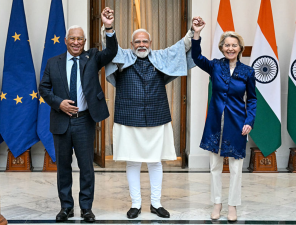
Calling the proposed Free Trade Agreement (FTA) between the European Union and India “the mother of all deals” may sound premature. The legal text is still awaited, negotiations are yet to be fully concluded, and much depends on implementation. Yet, beneath the celebratory rhetoric and symbolic gestures—such as promised tariff cuts on European wines—there are substantive reasons why this deal matters. Beyond trade numbers, the FTA reflects deeper shifts in geopolitics, economic strategy and the future direction of globalisation.
Why the EU–India Trade Deal Matters
At its core, the agreement brings together the world’s second- and fourth-largest economies. Taken together, the European Union and India account for roughly a quarter of global GDP and are home to nearly two billion people. The scale alone makes the deal consequential.
The proposed framework offers preferential market access to 99% of Indian exports to the EU. In return, Europe expects to double its goods exports to India by 2032. Employment creation, skill development, technological collaboration and improved labour mobility are expected spillover benefits, particularly for younger populations on both sides.
Europe’s Strategic Compulsion, India’s Strategic Choice
For Europe, the timing is critical. Its transatlantic relationship with the US has become increasingly strained, pressure to decouple from Russia has intensified, and dependence on the Chinese market has raised strategic anxieties. The FTA with India offers not just access to a large market, but a relatively stable and politically reliable partner.
India’s motivations differ. Its policy of multi-alignment has cushioned it from abrupt geopolitical shifts, but global trade expansion through multilateral routes has largely stalled. With the World Trade Organization offering little momentum post-Doha, and with regional neighbourhood challenges persisting, bilateral trade agreements with like-minded democracies appear a pragmatic path forward.
Trade as a Tool of Security and Strategy
The FTA is not merely an economic arrangement. It also carries national security and geoeconomic implications. By enabling supply-chain diversification and resilience in critical sectors, the agreement allows both sides to hedge against geopolitical shocks.
This strategic dimension is reinforced by the parallel Security and Defence Partnership announced at the summit. Together, they signal a shift from viewing trade purely as commerce to treating it as an instrument of geopolitical alignment and strategic autonomy.
The Pragmatism Behind the Negotiations
A notable feature of the deal is its method. Rather than sweeping liberalisation, the agreement reflects pragmatic carve-outs. The EU has excluded sensitive sectors such as beef, sugar and rice, while India has safeguarded dairy and cereals. These protections acknowledge domestic political realities and social sensitivities.
The language of the agreement also foregrounds democratic credentials and shared “core values”. This normative framing allows both sides to pursue economic interests while reinforcing political legitimacy, an approach increasingly relevant in a fragmented global order.
Lessons for a Post-WTO World
Disillusionment with multilateral trade negotiations has pushed many countries towards smaller, issue-linked agreements. The EU–India FTA illustrates how limited membership can be balanced with a wide scope, enabling trade-offs across sectors.
With the US withdrawing from dozens of multilateral organisations and demands for global governance reform growing louder, this negotiating experience offers lessons—both cautionary and constructive—for future trade diplomacy.
Towards a Different Model of Globalisation
Beyond economics and security lies a more ambitious question: can the EU and India jointly shape a better form of globalisation? Both emphasise democracy, human dignity and sustainability. India has championed the idea of LiFE (Lifestyle for the Environment), while European politics has seen strong advocacy for environmental protection and animal rights.
If backed by credible domestic action, cooperation in sustainability could give the partnership moral depth. A model of globalisation that is not only human-centric but planet-centric would mark a significant departure from extractive, growth-at-all-costs paradigms.
What to Note for Prelims?
- EU–India FTA covers economies accounting for ~25% of global GDP.
- 99% preferential access for Indian exports to the EU (proposed).
- Key features: supply-chain resilience, sectoral carve-outs, security linkages.
What to Note for Mains?
- Analyse the EU–India FTA as a geoeconomic and geopolitical instrument.
- Discuss why bilateral FTAs are gaining relevance amid WTO stagnation.
- Evaluate the scope for a sustainable, value-based model of globalisation.
- Examine trade agreements as tools of strategic autonomy and security.