
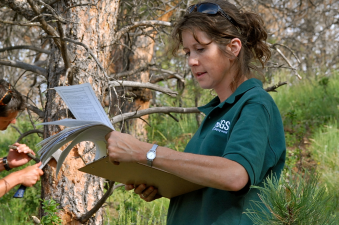
For generations, ecology was inseparable from physical fieldwork — trudging through forests, wetlands and reefs to observe life directly. Fieldwork was not just a research method but a professional identity. Today, however, artificial intelligence is quietly reshaping this relationship. Ecological research is increasingly shifting from forests to screens, from notebooks to algorithms. This transformation raises a fundamental question: does understanding nature still require physical presence?
Why Ecology Is Moving From Forests to Screens
The transition towards in silico ecology is driven primarily by an unprecedented explosion of data. Over a billion natural history specimens have been digitised worldwide, many linked to genetic databases. Citizen scientists contribute millions of observations through platforms like iNaturalist, while satellites, drones, camera traps, acoustic sensors and environmental DNA samplers continuously stream ecological data from across the planet.
Artificial intelligence systems can now classify species, track migration, model population trends and predict ecological futures — tasks that once required decades of painstaking field observation. As a result, ecological knowledge increasingly emerges from computational synthesis rather than physical immersion.
The Rise of ‘Screen Ecology’
In this new context, traditional fieldwork can appear inefficient. Why repeatedly visit remote forests when camera traps can operate year-round without disturbing wildlife? Why manually count species when AI-enabled systems can identify thousands of organisms automatically? Sensors never tire, forget or work selectively.
Automated systems offer clear scientific advantages:
- They reduce human disturbance in sensitive ecosystems.
- They operate in inaccessible or dangerous environments, such as deep oceans or dense canopies.
- They generate standardised, high-resolution data across large spatial and temporal scales.
In many cases, insisting on physical presence adds limited scientific value compared to analysing vast datasets already collected in the field.
When the Forest Comes to the Scientist
Modern ecosystems are increasingly saturated with technology. Camera traps are bolted to trees, microphones record soundscapes, drones scan vegetation, and satellites monitor phenology from space. AI does not merely supplement fieldwork; it replaces large portions of it. The forest now arrives at the scientist’s desk as streams of data.
What matters increasingly is not where the scientist stands, but how effectively the data are interpreted. Some of the most influential ecological insights today — on insect decline, invasive species or climate-driven shifts in flowering — emerge from computer-based analyses rather than direct observation.
Career Incentives and Scientific Pragmatism
There is also a practical dimension. Academic careers reward speed, scale and publication output. In silico research often produces results faster than long-term field studies, making extended physical fieldwork potentially career-limiting. In a competitive scientific environment, algorithms are often more rewarded than adventures.
This mirrors developments in other sciences. Not every physicist builds detectors, and not every biologist runs wet labs. Ecology, too, has reached a level of complexity that demands specialisation and division of labour.
The Fear of an ‘Extinction of Experience’
Despite these advantages, the shift is not without unease. Many ecologists warn of an “extinction of experience” — a loss of direct engagement with nature that could weaken ecological intuition, contextual understanding and ethical responsibility.
Concerns include:
- Biases embedded in data collection and AI training.
- Misinterpretation of patterns without field context.
- Over-reliance on models trained on incomplete or uneven datasets.
Critically, data are not neutral; they reflect how, where and why observations were collected. Without grounding in ecological realities, algorithms risk producing misleading conclusions.
Is Physical Presence Really Superior?
Yet the assumption that physical presence automatically ensures better understanding is itself questionable. Human observation is subjective, intermittent and limited. Robotic cameras do not tire, forget or selectively notice. AI systems can reveal patterns across scales invisible to the naked eye, uncovering ecological relationships no single field researcher could detect.
In this sense, in silico ecology is not necessarily a retreat from reality, but a way of seeing more — not less.
Redefining Fieldwork in the AI Age
The future of ecology is unlikely to be a simple choice between boots on the ground and laptops on desks. Instead, it offers an opportunity to redefine what “fieldwork” means. A camera trap fixed to a tree is as much a field instrument as a notebook once was. A machine-learning model trained on millions of observations can be as powerful a lens on nature as binoculars.
Forests, wetlands and reefs remain central to ecological science — but they no longer demand constant human presence. Knowledge increasingly emerges through technological mediation and analytical synthesis.
What to Note for Prelims?
- In silico ecology: computer-based ecological research using AI and big data.
- Key tools: camera traps, satellites, drones, environmental DNA, acoustic sensors.
- Citizen science platforms: iNaturalist.
What to Note for Mains?
- Discuss how AI is transforming ecological research methods.
- Analyse the benefits and risks of reduced physical fieldwork.
- Examine ethical and conservation challenges in data-driven ecology.
- Critically assess whether technological mediation weakens or strengthens environmental understanding.