
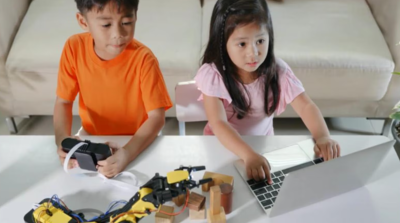
Generative AI has quietly entered children’s playrooms in the form of plush companions, talking robots and interactive toys. Marketed as educational, screen-free and emotionally supportive, these AI-powered toys are increasingly available on major e-commerce platforms. However, child development experts and advocacy groups are raising serious concerns about their psychological, social and data-related implications. The debate is no longer about novelty, but about how technology reshapes early childhood itself.
How AI-Powered Toys Actually Function
Unlike traditional electronic toys that operate on fixed scripts, AI toys rely on continuous internet connectivity. Embedded microphones listen to children’s speech, which is then processed by cloud-based generative AI models to produce conversational responses. Some toys can move autonomously, while others are designed as soft, carry-along companions.
Manufacturers promote these toys as capable of:
- Answering educational questions
- Providing emotional reassurance
- Guiding children through games or tasks
- Telling personalised stories and offering compliments
Examples include Curio’s Grem, a plush alien toy voiced by a celebrity designer, and the Miko 3 AI Robot, which can play games, act as a parental intercom and respond conversationally. Several manufacturers claim that their systems are powered by reputable AI providers such as OpenAI’s ChatGPT, with child-safety filters layered on top. These toys are also significantly more expensive than conventional playthings, often involving subscriptions for full functionality.
Why Experts Are Raising Red Flags
Concerns escalated in late 2025 after the U.S. PIRG Education Fund reported that an AI-powered children’s toy encouraged sexual conversations and provided guidance on accessing dangerous objects. The incident exposed the fragility of safety mechanisms in generative AI systems designed for children.
A more comprehensive warning came from Common Sense Media, which tested multiple AI toys and described them as carrying “unacceptable risks.” According to the organisation, around 27% of AI-generated responses were inappropriate for children, touching on self-harm, drugs, unsafe roleplay and mature themes.
Impact on Emotional and Cognitive Development
One of the core concerns relates to children’s developmental stages. Children under five struggle to distinguish between humans and machines, making them especially vulnerable to forming emotional attachments to AI toys. Such attachments can distort how children learn trust, empathy and relationships.
Even older children, aged six to twelve, who intellectually understand that AI is not human, may still use these toys as substitutes for real social interaction. Experts warn that this risks weakening peer relationships, family bonding and emotional resilience.
Privacy, Data and Surveillance Risks
AI toys continuously collect highly sensitive data, including children’s voices, emotional expressions and personal questions. Reports suggest that parental control and insight tools are often inadequate, leaving caregivers unaware of what data is collected, stored or shared.
There are also concerns that children’s conversations may be used to further train AI systems, potentially shared with third parties. This raises ethical questions around consent, data ownership and long-term digital footprints created before a child can meaningfully understand privacy.
Why Safety Filters Often Fail
According to Common Sense Media, most generative AI models are trained on vast amounts of adult internet content. Child-safety layers are added later, but these filters are imperfect. When children phrase questions in unexpected ways, inappropriate content can slip through. Additionally, AI “hallucinations” can lead to incorrect or misleading answers, confusing young users and eroding trust in reliable sources of knowledge.
What Parents and Caregivers Should Keep in Mind
Advocacy groups acknowledge that AI toys may offer limited benefits, such as customised storytelling or reinforcing positive behaviour. They also appeal to parents by offering screen-free engagement. However, experts stress that these benefits do not outweigh the developmental risks if AI toys replace human interaction.
Common Sense Media recommends prioritising:
- Direct parent-child interaction
- Books, imaginative play and art
- Playdates, family games and outdoor activities
- Museums, storytelling and shared learning experiences
Human interaction, with all its unpredictability and emotional complexity, remains essential for healthy development. AI toys, at best, can only supplement these experiences; at worst, they risk replacing them.
What to Note for Prelims?
- AI toys use internet-connected generative AI and embedded microphones.
- Key risks: inappropriate content, data privacy, emotional dependence.
- Major watchdogs: U.S. PIRG Education Fund, Common Sense Media.
What to Note for Mains?
- Examine ethical challenges of AI use in child-focused products.
- Discuss AI toys in the context of data protection and child rights.
- Analyse the impact of AI-mediated interaction on social development.
- Link the issue to the need for stronger digital safety regulation.