
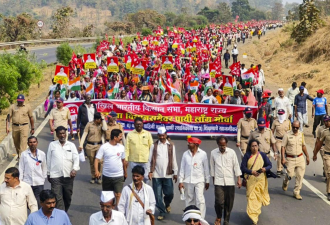
Over the past few days, Maharashtra has witnessed renewed tribal mobilisation, with thousands of Adivasi farmers undertaking long marches from the districts of Palghar and Nashik. Organised by the All India Kisan Sabha and the Communist Party of India (Marxist), the protests have once again brought the question of tribal land rights and development deficits to the centre of public debate. While local administrative assurances led to a partial pause in Palghar, the continuation of marches from Nashik underlines that the core issues remain unresolved.
Why Palghar and Nashik Matter in Maharashtra’s Tribal Geography
Both Palghar and Nashik have a significant tribal population, largely dependent on rain-fed agriculture and forest-based livelihoods. Despite constitutional protections and special laws, these regions continue to show weak development indicators in irrigation, education, and employment. The long marches are therefore not isolated protests but part of a longer history of Adivasi assertion for dignity, recognition and economic security.
The Core Demands: Land, Livelihood and Local Governance
At the heart of the protests lies the demand for effective implementation of the Forest Rights Act, 2006. Tribal farmers argue that forest land cultivated by them for generations must be legally recorded in their individual names. According to them, the current format of land titles — often issued at the village level or with incomplete individual details — prevents access to institutional credit, crop insurance and government welfare schemes.
Beyond land rights, the demands reflect broader development concerns:
- Construction of small dams and local river-linking projects to address chronic water scarcity.
- Diversion of west-flowing rivers through minor structures to irrigate drought-prone eastern tracts.
- Extension of Minimum Support Price (MSP) beyond paddy to crops such as millets, pulses, oilseeds, fruits and vegetables.
- Completion of pending recruitments under the to generate local employment.
- Filling vacancies in Zilla Parishad schools, improving educational access, and ensuring reliable electricity supply.
Where the System Is Breaking Down
Tribal groups argue that the rejection of individual claims under the Forest Rights Act has become routine rather than exceptional. Many claimants are allotted only a fraction of the land they cultivate, rendering them technically ineligible for benefits linked to landholding size. Another grievance is that digitisation of land records has introduced discrepancies, leading to exclusions and denials.
The persistence of these issues since at least 2018 suggests that the problem is not merely administrative delay but structural interpretation. The continued dominance of forest departments in decision-making often clashes with the spirit of the Act, which envisages community-led forest governance.
Government’s Position and the Data on Forest Rights
The Government of Maharashtra acknowledges the stress points but maintains that implementation is proceeding incrementally. According to data presented in Parliament in July 2025, the State has disposed of over 3.8 lakh claims out of roughly 4.1 lakh filed under the Forest Rights Act. Of these, about 2.08 lakh titles were granted, while nearly 1.73 lakh claims were rejected, leaving a pendency of over 28,000 cases.
Following recent protests, the State government held talks with protest leaders. Chief Minister Devendra Fadnavis stated that the government was positive about resolving outstanding issues, even as officials conceded that differences in interpretation of the law persist.
Conservation Versus Rights: An Unresolved Tension
The late ecologist Madhav Gadgil had repeatedly warned that misreading the Forest Rights Act creates anomalies. He argued that India’s conservation discourse often treats human presence in forests as a threat, whereas the Act integrates forest dwellers into conservation and management. This ideological tension — conservation versus forest rights — continues to shape ground-level outcomes in tribal regions.
Why These Marches Matter Beyond Maharashtra
The Palghar and Nashik marches highlight a national challenge. Laws such as the Forest Rights Act and PESA were designed to correct historical injustices, but their impact depends on administrative will and interpretive clarity. Persistent mobilisation signals that legal recognition without economic and institutional support is insufficient.
What to Note for Prelims?
- Forest Rights Act, 2006: aims and implementation challenges.
- PESA Act, 1996 and its role in tribal self-governance.
- High rejection rates of forest rights claims in Maharashtra.
- Role of farmers’ organisations in tribal movements.
What to Note for Mains?
- Link between land rights, credit access and tribal livelihoods.
- Conflict between conservation policies and tribal rights.
- Implementation gaps in special laws for Scheduled Areas.
- Relevance of grassroots mobilisation in strengthening federal and democratic accountability.
The long marches from Palghar and Nashik are reminders that development without rights remains fragile. Until land tenure, water access and local governance converge meaningfully on the ground, tribal protest will remain a recurring feature of India’s political landscape.
Last Modified: February 4, 2026