
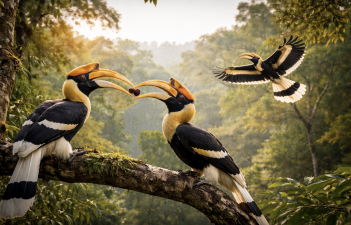
In a novel conservation initiative, the Chhattisgarh Forest Department has begun establishing six “hornbill restaurants” in the Udanti Sitanadi Tiger Reserve (USTR) in Gariaband district. The move aims to provide sustained food availability for the Malabar Pied Hornbill while encouraging natural forest regeneration. What makes this effort noteworthy is that the bird — traditionally associated with the Western Ghats — has shown a steady rise in sightings in central India, prompting habitat-focused intervention.
The Malabar Pied Hornbill’s Unusual Central India Presence
4
The Malabar Pied Hornbill (Anthracoceros coronatus) is a large, striking bird measuring about 2–2.5 feet in height, characterised by a massive casque-topped beak and black-and-white plumage.
Traditionally found in the Western Ghats, it was first documented in Udanti Sitanadi Tiger Reserve in 2017. Since then, sightings have steadily increased — from occasional observations to weekly encounters.
Currently, an estimated 400–500 hornbills inhabit the reserve’s three ranges: Kulhadighat, Indagaon, and South Udanti. In 2024, the International Union for Conservation of Nature listed the species as “Near Threatened,” with a global population estimated between 3,000 and 32,000 mature individuals.
What Are ‘Hornbill Restaurants’?
4
Despite the term, hornbill restaurants are not artificial feeding stations. Instead, they are carefully developed clusters of fruit-bearing trees — particularly peepal, banyan, and other ficus species — which form the hornbill’s primary diet.
The initiative includes:
- Planting fig-rich patches to ensure year-round fruit availability.
- Identifying and nurturing nesting trees.
- Restoring degraded patches near villages.
One such “restaurant” has already been created in the Sornammal area, where 40 hectares were planted with peepal and banyan trees. Another project involves planting 100 fig trees across two hectares near Ondh village.
Hornbills as Keystone Seed Dispersers
Hornbills play a vital ecological role. They are recognised as keystone seed dispersers in tropical forests.
By consuming large quantities of fruits and dispersing seeds over long distances, they:
- Promote forest regeneration.
- Maintain plant diversity.
- Support the survival of large-seeded tree species.
Thus, supporting hornbills indirectly strengthens the broader forest ecosystem. The initiative is as much about landscape restoration as species protection.
Habitat Suitability and Emerging Ecological Shifts
About 60% of USTR consists of mountainous terrain, reaching elevations up to 1,000 metres. The climate resembles parts of the Western Ghats, potentially explaining the hornbill’s expanding presence.
However, ecological pressures remain. Natural predators such as leopards, snakes, and the Indian Shaheen Falcon are present in the reserve. Hunting for meat has also historically targeted hornbills and other wildlife.
Forest authorities have responded with:
- Arrest of over 500 poachers and encroachers in the past three years.
- Drone surveillance to prevent poaching and forest fires.
- Training five dedicated hornbill-tracking teams using point-and-shoot cameras.
Local ecological knowledge is being integrated into scientific monitoring.
Community Interface and Eco-Tourism Potential
Planting fruit trees near village buffer zones serves dual purposes:
- Providing safer observation opportunities for residents.
- Encouraging eco-tourism in the region.
Such initiatives aim to build community support by linking conservation outcomes with livelihood benefits.
Broader Conservation Significance
The concept of “hornbill restaurants” reflects a shift toward habitat-based conservation rather than species-centric isolation. Instead of relying solely on protection measures, the focus is on ensuring ecological conditions that naturally sustain wildlife populations.
If successful, the model could be replicated in other reserves facing habitat fragmentation or species range shifts due to climate change.
What to Note for Prelims?
- Species: Malabar Pied Hornbill (Anthracoceros coronatus).
- Status: Near Threatened (IUCN Red List, 2024).
- Location: Udanti Sitanadi Tiger Reserve, Chhattisgarh.
- Primary diet: Ficus species (peepal, banyan).
- Ecological role: Keystone seed disperser.
What to Note for Mains?
- Habitat-based conservation strategies.
- Role of keystone species in forest regeneration.
- Community participation in wildlife conservation.
- Impact of climate and landscape features on species distribution.
- Balancing eco-tourism and biodiversity protection.