
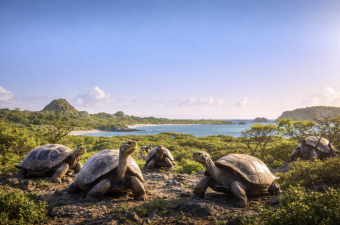
More than a century after their disappearance, giant tortoises have been reintroduced to Floreana Island in Ecuador’s iconic Galapagos archipelago. The move marks a significant milestone in global rewilding efforts and ecosystem restoration. With 158 tortoises carefully transported and released across rugged volcanic terrain, conservation authorities hope to revive a lost ecological balance on one of the most historically altered islands in the Pacific.
Why the Return of Tortoises Matters
The reintroduction was carried out by Ecuador’s Environment Ministry and the Galapagos National Park, with support from conservation groups such as Island Conservation.
Giant tortoises are described as “ecosystem engineers” because they:
- Disperse seeds across large distances
- Regulate vegetation growth
- Promote natural habitat regeneration
- Maintain open landscapes critical for biodiversity
Their absence from Floreana for over 100 years disrupted these ecological functions, contributing to habitat imbalance.
Historical Extinction and Human Impact
Floreana Island, part of the Galápagos Islands, once hosted the endemic species Chelonoidis niger niger. However, by the mid-19th century, the tortoises were driven to local extinction due to overexploitation by sailors and settlers, and the introduction of invasive mammals.
Floreana, covering 173 square kilometres, was the first island in the archipelago to be permanently inhabited by humans. Human settlement accelerated ecological degradation, altering native vegetation and wildlife patterns.
Scientific Basis of the Reintroduction
The newly released tortoises were bred at a specialized centre managed by Galapagos National Park. Scientists identified individuals with a high genetic load of the original Floreana lineage, traced to tortoises found on Isabela Island — located about 180 kilometres away.
Before release:
- Each tortoise underwent quarantine procedures
- Health assessments were conducted
- Microchips were implanted for identification and monitoring
The reintroduction effort is part of a decade-long ecological restoration plan that also aims to restore 12 other endemic species on Floreana.
Galapagos: A Global Laboratory of Evolution
The Galapagos Islands lie roughly 1,000 kilometres off Ecuador’s coast and are a UNESCO World Heritage Site. They are globally renowned for their unique biodiversity and role in shaping evolutionary science, particularly through the observations of Charles Darwin, which contributed to the theory of natural selection.
Currently, 13 living species of Galapagos tortoises survive across different islands in the archipelago. These tortoises can weigh over 250 kilograms and are among the longest-living vertebrates, with recorded lifespans exceeding 170 years.
Rewilding as a Conservation Strategy
Rewilding refers to restoring ecosystems by reintroducing keystone species that perform critical ecological functions. The Floreana initiative demonstrates several broader conservation principles:
- Use of genetic science in species recovery
- Long-term monitoring through tagging and microchipping
- Removal or management of invasive species
- Community and governmental collaboration
Such projects aim not merely to conserve species, but to rebuild entire ecosystems.
Challenges Ahead
Despite the symbolic success, challenges remain:
- Managing invasive species that previously caused extinction
- Ensuring long-term habitat stability
- Monitoring reproduction and adaptation
- Balancing tourism with ecological protection
Given Floreana’s human history and ecological fragility, sustained conservation efforts will be essential.
What to Note for Prelims?
- Floreana Island is part of the Galapagos archipelago of Ecuador.
- 158 giant tortoises reintroduced after more than 100 years.
- Extinct local species: Chelonoidis niger niger.
- Galapagos Islands are a UNESCO World Heritage Site.
- Giant tortoises act as ecosystem engineers.
What to Note for Mains?
- Discuss the concept of rewilding and its ecological significance.
- Examine the role of keystone species in ecosystem restoration.
- Analyse how invasive species contribute to biodiversity loss.
- Evaluate global conservation efforts in biodiversity hotspots.