
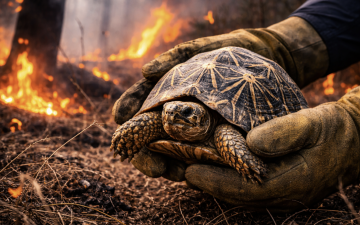
A slow-moving star-shelled tortoise found itself in the path of a fast-spreading ground fire in the Amrabad Tiger Reserve, but timely human intervention ensured its safety. Forest personnel battled the blaze for nearly 20 hours in the Domalapenta range, where around 60 hectares of fallen leaf litter were burnt. Amid the firefighting effort, a passing medical officer rescued the vulnerable reptile from the highway stretch cutting through the reserve, preventing possible fatal injury.
Ground Fires and the Hidden Threat to Wildlife
Forest officials described the blaze as limited in scale, yet ground fires — often fueled by dry leaf litter — pose disproportionate risks to small and slow-moving fauna.
Species particularly vulnerable include:
- Tortoises and turtles
- Ground-nesting birds
- Snakes and small reptiles
- Insects and microfauna essential to soil health
Unlike large mammals that can flee rapidly, such animals are often trapped by advancing flames or succumb to heat and smoke inhalation.
Ecological Significance of Amrabad Tiger Reserve
Amrabad Tiger Reserve forms part of the larger Nallamala forest landscape and is one of India’s significant tiger habitats. Besides tigers and large mammals, the reserve supports diverse reptilian and avian species.
The incident occurred near Brahmagiri (formerly Domalapenta), close to a national highway passing through the reserve — highlighting the intersection of wildlife habitats and human infrastructure. Roads cutting across protected areas often increase risks during emergencies, including fires.
Conservation Status of the Star-Shelled Tortoise
The rescued reptile is the Indian star tortoise, scientifically known as Geochelone elegans. It is listed as “Vulnerable” by the International Union for Conservation of Nature (IUCN).
Major threats to the species include:
- Habitat degradation
- Forest fires
- Illegal poaching for the pet trade
- Road mortality
The Nallamala forests are among its natural habitats in southern India. Despite legal protection under the Wildlife Protection Act, the species continues to face pressure from illicit trafficking networks.
Forest Fires in Dry Deciduous Ecosystems
The Nallamala region largely consists of dry deciduous forests, which are particularly susceptible to seasonal fires during dry months. Ground fires typically burn leaf litter rather than tree canopies, but repeated burning can:
- Degrade soil nutrients
- Disrupt seed germination cycles
- Reduce undergrowth biodiversity
- Alter microhabitats for reptiles and amphibians
Climate variability and rising temperatures may further intensify fire frequency and spread.
Human Intervention and Conservation Awareness
The tortoise was rescued by a medical officer from the Integrated Tribal Development Agency (ITDA), who transported it to forest authorities for safe relocation. Such citizen intervention underscores the role of public awareness in wildlife protection.
While institutional firefighting efforts remain central, individual acts can significantly reduce casualties among vulnerable species.
What to Note for Prelims?
- Amrabad Tiger Reserve is located in Telangana and forms part of the Nallamala forests.
- Indian star tortoise (Geochelone elegans) is listed as Vulnerable by the IUCN.
- Ground fires mainly burn leaf litter but can harm slow-moving fauna.
- Nallamala forests are a habitat for star-shelled tortoises.
What to Note for Mains?
- Discuss the ecological impact of forest fires on dry deciduous ecosystems.
- Examine conservation challenges faced by reptiles in protected areas.
- Analyse the role of citizen participation in wildlife conservation.
- Evaluate the impact of infrastructure such as highways on biodiversity in tiger reserves.