
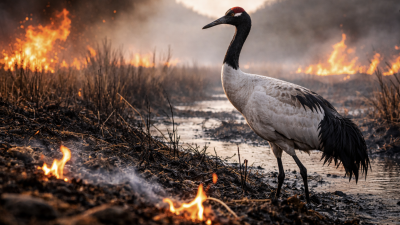
Each summer, the high-altitude wetlands of Ladakh echo with the resonant calls of the black-necked crane — a bird revered across the Tibetan and Trans-Himalayan plateau. Towering nearly 1.4 metres tall, with its white-grey body, jet-black head and striking red eye patch, the crane is both an ecological sentinel and a cultural symbol. Yet despite legal protections and deep-rooted community reverence, its fragile population in India is under mounting stress.
A High-Altitude Specialist of the Tibetan Plateau
Black-necked crane breeds at elevations ranging from 2,600 to 4,900 metres, primarily across the Qinghai-Tibetan plateau. Globally, only 13,000–15,000 individuals survive, and the species is classified as Near Threatened by the International Union for Conservation of Nature (IUCN).
In India, its breeding stronghold lies in Ladakh, with wintering populations also reported in Arunachal Pradesh. Locally known as “cha thung-thung” in Ladakh and “thungdung karma” in Arunachal Pradesh, the crane shares a long cultural association with pastoral communities.
A defining trait of the species is strong site fidelity — breeding pairs return year after year to the same wetlands, building simple nests of sedges and grasses in marshy meadows.
Declining Breeding Success in Ladakh
Recent observations from the Hanle wetlands illustrate the scale of the problem. Once home to four breeding pairs, the area now supports only one or two pairs, often with unsuccessful nesting attempts.
Key threats include:
- Habitat fragmentation due to expanding settlements
- Encroaching agriculture in fragile alpine wetlands
- Unregulated construction activities
- Electric poles and renewable energy infrastructure
Large-scale wind and solar proposals, while critical for India’s clean energy goals, risk disturbing the open landscapes essential for crane breeding.
Free-Ranging Dogs and Nest Predation
Perhaps the most immediate threat comes from packs of free-ranging dogs maintained by army units, herders, and nomadic groups. These dogs frequently raid nests, consuming eggs and chicks.
At several sites, repeated predation has led to complete breeding failure across multiple seasons. Unlike natural predators, the high density of human-supported dog populations intensifies ecological imbalance.
Livestock Pressure and Grassland Degradation
Nearly 90% of Ladakh’s population depends on livestock. Growing herds of sheep, goats, and yak have led to overgrazing of delicate wetlands.
Consequences include:
- Reduction in nesting cover
- Loss of invertebrate prey base
- Soil compaction and wetland shrinkage
- Conversion of traditional pastures into cultivated fields
Such transformations alter the ecological character of high-altitude grasslands that cranes depend upon.
Tourism and Changing Human Activity Patterns
Tourism in Ladakh has expanded significantly, with peak tourist months overlapping the crane’s breeding season. Around wetlands such as Tsomoriri and Tsokar, disturbance from vehicles, trekkers, and photographers often forces adults off nests, exposing eggs to cold and predation.
Much of the species’ habitat lies outside formally protected areas, making it vulnerable to unregulated access and infrastructure expansion.
Climate Change in the Trans-Himalaya
The Himalayan region is warming faster than the global average. While slightly milder winters may reduce seasonal mortality, long-term risks are severe:
- Glacial retreat reducing water inflow to wetlands
- Shrinking marshes and alpine bogs
- Altered hydrological cycles
- Increased frequency of extreme weather events
Wetlands such as Pangchen Schoktsen Lakhar Community Conservation Area (108 sq km) are critical habitats that require stronger legal protection to withstand these pressures.
Legal Protection and Conservation Gaps
The black-necked crane receives the highest level of protection under Indian law:
- Listed under Schedule I of the Wildlife (Protection) Act, 1972
- Included in Appendices I and II of CITES
- Protected under the Convention on Migratory Species (CMS)
Despite this robust legal framework, implementation gaps persist because many breeding and wintering grounds fall outside notified protected areas.
Way Forward: Integrated Conservation Strategy
Safeguarding the species requires coordinated and community-sensitive action:
- Regulating tourism near nesting wetlands
- Strict control and sterilisation of free-ranging dog populations
- Scientific assessment of renewable energy siting
- Legal protection for key community conservation areas
- Community-based wetland stewardship models
The black-necked crane’s haunting call remains a defining soundscape of the Trans-Himalaya. Its survival will depend not merely on statutory safeguards, but on harmonising development, climate adaptation, and traditional livelihoods in one of the world’s most fragile ecosystems.
What to Note for Prelims?
- Black-necked crane (Grus nigricollis) is listed as Near Threatened by IUCN.
- Protected under Schedule I of the Wildlife (Protection) Act, 1972.
- Included in CITES Appendices I and II and protected under CMS.
- Breeds in high-altitude wetlands of Ladakh (2,600–4,900 m).
- Major threats: habitat loss, dog predation, overgrazing, climate change.
What to Note for Mains?
- Discuss challenges of biodiversity conservation in high-altitude ecosystems.
- Examine the conflict between renewable energy expansion and wildlife habitats.
- Analyse the role of community-based conservation in fragile landscapes.
- Evaluate the impact of climate change on Himalayan wetland ecosystems.