
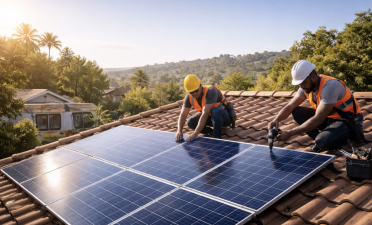
India’s flagship household solar initiative — PM Surya Ghar: Muft Bijli Yojana — has crossed 30 lakh rooftop installations within a year of its launch in February 2024. The milestone signals accelerating adoption of distributed renewable energy and reflects the Centre’s push to combine energy security, climate action, and household savings.
What Is PM Surya Ghar: Muft Bijli Yojana?
Launched in February 2024, the PM Surya Ghar scheme aims to install rooftop solar systems in one crore (10 million) households by 2026–27. The programme seeks to provide free electricity up to a specified limit by enabling households to generate their own solar power.
The scheme is implemented by the Ministry of New and Renewable Energy under the leadership of Union Minister [“Pralhad Joshi”,”indian politician”].
Key objectives include:
- Reducing household electricity bills
- Promoting decentralised renewable energy generation
- Lowering India’s carbon footprint
- Reducing pressure on conventional power grids
What the 30 Lakh Milestone Signifies
Crossing 30 lakh installations demonstrates both administrative push and consumer acceptance. Rooftop solar is considered a critical component of India’s broader renewable energy strategy because it:
- Utilises idle rooftop space in urban and semi-urban areas.
- Reduces transmission and distribution losses.
- Strengthens energy access at the household level.
- Encourages citizen participation in climate mitigation.
If the target of one crore households is achieved, the rooftop systems are projected to generate around 1,000 billion units (BU) of renewable electricity over their operational lifetime.
Climate Impact and Emission Reductions
According to government estimates, rooftop systems installed in one crore households could reduce approximately 720 million tonnes of CO₂ emissions over 25 years.
This aligns with India’s climate commitments under the Paris Agreement and its nationally determined contributions (NDCs), which include:
- Reducing emissions intensity of GDP.
- Expanding non-fossil fuel-based power capacity.
- Moving towards net-zero emissions by 2070.
Distributed solar generation complements utility-scale solar parks by broadening the renewable energy base and making climate action more participatory.
Energy Security and Economic Dimensions
India remains heavily dependent on imported fossil fuels, especially crude oil and natural gas. Rooftop solar contributes to:
- Reduced dependence on fossil fuel imports.
- Lower peak demand pressure on power utilities.
- Job creation in installation, maintenance, and manufacturing sectors.
- Growth of domestic solar manufacturing under Atmanirbhar Bharat.
Households benefit from reduced electricity bills, and surplus power can be fed back into the grid under net-metering arrangements.
Implementation Challenges and Policy Considerations
Despite rapid progress, certain challenges persist:
- Upfront installation costs, despite subsidies.
- Awareness gaps in rural and low-income areas.
- Grid integration and net-metering regulatory variations across states.
- Quality assurance and maintenance standards.
Addressing these bottlenecks is essential to sustain the pace of installations and meet the one-crore target within the stipulated timeline.
What to Note for Prelims?
- PM Surya Ghar: Muft Bijli Yojana launched in February 2024.
- Target: 1 crore rooftop solar installations by 2026–27.
- 30 lakh households have already installed systems.
- Estimated generation: 1,000 billion units over lifetime.
- Projected reduction: 720 million tonnes of CO₂ over 25 years.
What to Note for Mains?
- Discuss the role of decentralised renewable energy in strengthening India’s energy security.
- Examine rooftop solar as a tool for climate mitigation and citizen participation.
- Analyse challenges in implementing large-scale distributed solar programmes.
- Evaluate how rooftop solar contributes to India’s net-zero and NDC commitments.