
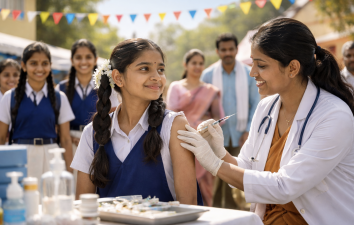
India is set to launch a nationwide Human Papillomavirus (HPV) vaccination programme targeting 14-year-old girls, marking a major step in the country’s fight against cervical cancer. The vaccine will be voluntary and provided free of cost through government health facilities, signalling a shift from pilot projects to a structured national strategy for cancer prevention.
Why Cervical Cancer Remains a Public Health Concern
4
Cervical cancer is the second most common cancer among women in India. Each year, the country records nearly 80,000 new cases and over 42,000 deaths. What makes this burden particularly concerning is that cervical cancer is largely preventable.
Scientific evidence shows that persistent infection with high-risk HPV types — especially types 16 and 18 — accounts for more than 80% of cervical cancer cases in India. Since HPV infection typically occurs soon after sexual debut, vaccination before exposure offers the strongest protection.
Key Features of the National HPV Programme
The Union Health Ministry will administer Gardasil, a quadrivalent vaccine that protects against:
- HPV types 16 and 18 (linked to cervical cancer)
- HPV types 6 and 11 (associated with genital warts)
The programme’s salient features include:
- Target group: Girls aged 14 years
- Voluntary and free of cost vaccination
- Single-dose schedule based on global and Indian scientific evidence
- Administration exclusively at government facilities
Vaccination sessions will be conducted at Ayushman Arogya Mandirs (Primary Health Centres), Community Health Centres, Sub-District and District Hospitals, and Government Medical Colleges. All sites will be linked to 24×7 health facilities to manage rare adverse events and ensure post-vaccination monitoring.
Single-Dose Strategy and Global Evidence
4
Globally, over 90 countries have adopted single-dose HPV vaccination schedules to improve coverage and affordability. Evidence suggests that a single dose provides robust and durable protection when administered in the recommended age group.
India’s procurement of vaccines has been facilitated under its partnership with Gavi, the Vaccine Alliance, ensuring quality standards and uninterrupted supply. The vaccines used are approved by India’s drug regulator and have been administered in over 500 million doses worldwide since 2006, demonstrating a strong safety profile.
Institutional Backing and Policy Rationale
The decision is grounded in recommendations from the National Technical Advisory Group on Immunisation (NTAGI), which evaluates scientific data before inclusion of vaccines in national programmes.
The strategy aligns with three policy priorities:
- Preventive healthcare under Universal Health Coverage.
- Gender-sensitive health interventions targeting adolescent girls.
- Reduction of long-term cancer treatment costs through early prevention.
By integrating HPV vaccination into the public health system, India aims to bridge socio-economic disparities in access to preventive oncology services.
Vaccination Is Not a Substitute for Screening
While HPV vaccination significantly reduces the risk of cervical cancer, it does not eliminate the need for regular screening. Pap smears and HPV testing remain essential because:
- The vaccine does not cover all cancer-causing HPV types.
- Some women may have been exposed to HPV before vaccination.
- Screening detects pre-cancerous changes early.
Thus, a dual approach — vaccination plus screening — is critical for long-term cervical cancer elimination.
Challenges in Implementation
Despite strong evidence, the programme may face operational and social challenges:
- Vaccine hesitancy and misinformation.
- Ensuring coverage in rural and remote areas.
- Cold chain maintenance and monitoring.
- Awareness gaps regarding HPV and cervical cancer.
Sustained community engagement and school-based awareness campaigns will be key to achieving high uptake.
What to Note for Prelims?
- HPV types 16 and 18 are high-risk strains linked to cervical cancer.
- Gardasil is a quadrivalent HPV vaccine.
- NTAGI recommends inclusion of vaccines in India’s immunisation schedule.
- HPV vaccines are non-live vaccines and cannot cause HPV infection.
What to Note for Mains?
- Discuss the role of preventive vaccination in reducing cancer burden in India.
- Examine challenges in adolescent immunisation programmes.
- Analyse how partnerships with global health institutions like Gavi strengthen public health delivery.
- Evaluate the importance of integrating vaccination with cancer screening for disease elimination.