
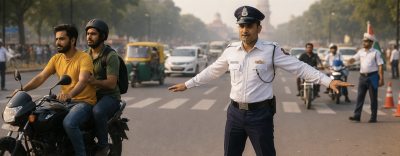
Delhi has decided to adopt the Centre’s ‘Rah-Veer’ scheme, a programme aimed at encouraging citizens to assist road accident victims during the critical “golden hour.” By offering a cash reward of ₹25,000 to individuals who ensure that a seriously injured person reaches a hospital in time, the government seeks to address a long-standing public health challenge — bystander hesitation.
Why the Golden Hour Matters in Road Accidents
4
The “golden hour” refers to the first 60 minutes following a traumatic injury. Medical evidence shows that prompt intervention during this window significantly improves survival chances, particularly in cases of severe bleeding, head injuries, or internal trauma.
India records one of the highest numbers of road accident fatalities globally. Delays in medical attention — often due to fear or confusion among bystanders — contribute substantially to preventable deaths. The Rah-Veer scheme attempts to bridge this gap by incentivising immediate assistance.
Key Features of the Rah-Veer Scheme
The scheme offers the following benefits:
- ₹25,000 reward for helping transport a seriously injured victim to a hospital within the golden hour.
- A certificate of recognition for the rescuer.
- Annual national award of ₹1 lakh for ten selected individuals.
Even if multiple victims are assisted in a single accident, the rescuer will receive a maximum of ₹25,000 for that particular incident. Rewards will be transferred directly to beneficiaries’ bank accounts after due verification.
The announcement was made by Delhi Chief Minister Rekha Gupta as part of the city’s broader road safety and emergency response reforms.
Legal Protection Under Good Samaritan Rules
The Rah-Veer scheme is anchored in the Good Samaritan provisions under the Motor Vehicles (Amendment) Act, 2019.
These rules ensure that:
- Bystanders who voluntarily help accident victims are protected from civil and criminal liability.
- They cannot be compelled to disclose personal details unless they choose to.
- Police procedures remain simplified and non-harassing.
Despite these safeguards, social hesitation persists. By combining legal protection with financial incentives, the government aims to create behavioural change and public confidence.
Institutional Oversight and Transparency Mechanism
To ensure accountability, a District Level Evaluation Committee will review claims. The committee includes:
- District Magistrate
- Senior police officers
- Chief Medical Officer
- Regional Transport Officer
Such a multi-agency mechanism is intended to prevent misuse while maintaining prompt disbursement through online transfers.
Public Health and Governance Implications
The scheme highlights the intersection of road safety, public health policy, and citizen participation.
Its broader objectives include:
- Reducing road accident fatalities.
- Encouraging community-led emergency response.
- Improving coordination between police, hospitals, and transport authorities.
- Building trust between citizens and law enforcement.
If implemented effectively, Rah-Veer could complement other initiatives such as trauma care strengthening and road safety audits.
Behavioural Economics Behind the Incentive Model
From a policy perspective, Rah-Veer reflects the use of behavioural nudges. While moral responsibility already exists, monetary incentives act as catalysts to overcome psychological and legal fears.
The approach recognises that:
- Fear of police harassment deters intervention.
- Lack of awareness about Good Samaritan protections persists.
- Visible recognition can create positive social norms.
Such incentive-based models are increasingly used in public policy to address coordination failures in emergencies.
What to Note for Prelims?
- The “golden hour” refers to the first hour after traumatic injury.
- Good Samaritan protections are embedded in the Motor Vehicles (Amendment) Act, 2019.
- Rah-Veer offers ₹25,000 reward for assisting accident victims.
- District Level Committees verify eligibility before disbursement.
What to Note for Mains?
- Discuss the role of citizen participation in road safety governance.
- Examine the effectiveness of incentive-based public policy interventions.
- Analyse challenges in implementing Good Samaritan protections in India.
- Evaluate how emergency response reforms can reduce accident fatalities.