
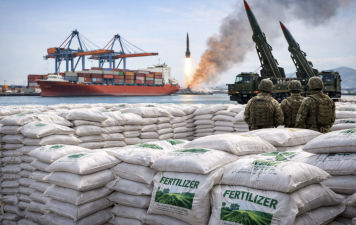
India remains largely dependent on fertiliser imports despite being self-sufficient in many crops. In 2025-26, India is projected to import nearly 10 million tonnes of urea and 6.5 million tonnes of di-ammonium phosphate (DAP). The entire consumption of muriate of potash (MOP) is imported. Complex fertilisers are partly produced domestically but also rely on imports. This dependence exposes India’s agriculture to geopolitical risks, especially due to ongoing conflicts in West Asia and supply chain vulnerabilities.
Fertiliser Import Sources and Geopolitical Impact
India imports share of fertilisers from Gulf Cooperation Council (GCC) countries such as Oman, Qatar, Saudi Arabia, UAE, and Bahrain. Around 75% of India’s urea imports come from these nations. Saudi Arabia is the largest supplier of DAP. Russia, despite the Ukraine war, remains a top supplier of MOP and urea. China was a major source until recently. The ongoing US-Israel versus Iran conflict and the Russia-Ukraine war show India’s exposure to supply disruptions.
Raw Materials and Energy Dependencies
India lacks domestic reserves of key raw materials like rock phosphate, potash, and elemental sulphur. These are mostly imported from West Asia, North Africa, and other regions. Domestic urea production depends heavily on natural gas, with fertilisers consuming nearly 29% of India’s total gas usage. Over half of India’s natural gas is imported, primarily as liquefied natural gas (LNG) from Qatar, UAE, and Oman. Ammonia, a key input for DAP and complex fertilisers, is also mostly imported.
Stock Levels and Supply Challenges
India currently holds comfortable fertiliser stocks, with urea, DAP, and complex fertilisers above last year’s levels. This is due to increased imports from diverse countries including Indonesia, Malaysia, Egypt, and Australia. However, domestic production is constrained by limited gas availability, with plants running at about 60% capacity. Maintenance shutdowns before peak seasons add to supply risks. Any prolonged conflict affecting shipping routes, especially the Strait of Hormuz, could disrupt imports of LNG, ammonia, and sulphur.
Future Outlook and Strategic Measures
India may need to diversify LNG and ammonia imports from the US, Australia, Angola, Cameroon, Indonesia, Malaysia, and China. The government could prioritise natural gas allocation to fertiliser production and city gas distribution to safeguard food security and energy needs. Alternative shipping routes through the Black Sea and Cape of Good Hope are options if the Strait of Hormuz remains blocked. Strategic planning is essential to manage geopolitical uncertainties affecting agriculture inputs.
Topics for Prelims:
Fertiliser Types and Nutrients
- Urea supplies nitrogen (N) for crops.
- Di-ammonium phosphate (DAP) provides phosphorus (P) and nitrogen.
- Muriate of potash (MOP) supplies potassium (K).
- Complex fertilisers contain combinations of N, P, K, and sulphur (S).
- Essential nutrients increase crop yield and quality.
Key Fertiliser Import Sources
- GCC countries supply 75% of India’s urea imports.
- Saudi Arabia is the largest DAP supplier.
- Russia is top MOP supplier.
- Natural gas for urea is imported mainly as LNG from Qatar, UAE, Oman.
- Phosphoric acid and rock phosphate are imported from Jordan, Morocco, Senegal, Tunisia.
Geopolitical Risks and Supply Routes
- US-Israel vs Iran war threatens Strait of Hormuz shipping.
- Russia-Ukraine war disrupts ammonia and sulphur exports.
- Blocked shipping routes may force longer import routes via Suez Canal or Cape of Good Hope.
- War risk insurance and physical security issues hamper vessel movement.
- India must diversify import sources to reduce risk.
Questions for Mains:
- Critically discuss the impact of geopolitical conflicts on India’s agricultural input security with examples from West Asia. [GS-III-Economic Development]
- Analyse the role of natural gas imports in India’s fertiliser production and its implications for energy security. [GS-III-Economic Development]
- With suitable examples, discuss the challenges and strategies for India to reduce its dependence on fertiliser imports in the context of global supply chain disruptions. [GS-III-Economic Development]
- Examine how disruptions in international maritime routes such as the Strait of Hormuz affect India’s trade and energy security, and suggest policy measures to mitigate these risks. [GS-II-International Relations]
Answer Hints:
1. Critically discuss the impact of geopolitical conflicts on India’s agricultural input security with examples from West Asia. [GS-III-Economic Development]
- India imports major fertilisers (urea, DAP, MOP) and raw materials from West Asia (GCC countries, Saudi Arabia, Oman, UAE).
- Ongoing US-Israel vs Iran conflict threatens key shipping routes (Strait of Hormuz), disrupting LNG, ammonia, sulphur imports essential for fertiliser production.
- Russia-Ukraine war affects ammonia and sulphur exports from Russia, increasing prices and causing supply shortages.
- Dependence on geopolitically unstable regions exposes India’s agriculture to supply shocks and price volatility.
- Import disruptions can reduce fertiliser availability, impacting crop yields and food security.
- Current stockpiles provide temporary buffer, but prolonged conflicts pose serious risks.
2. Analyse the role of natural gas imports in India’s fertiliser production and its implications for energy security. [GS-III-Economic Development]
- Natural gas is a key feedstock for domestic urea production, accounting for nearly 29% of India’s total gas consumption.
- Over 50% of India’s natural gas (mainly LNG) is imported from Qatar, UAE, Oman—regions vulnerable to geopolitical tensions.
- Inadequate gas supply limits urea plants’ capacity utilization (~60%), affecting domestic fertiliser output.
- Dependence on imported LNG links fertiliser security directly to energy security and global gas market volatility.
- Energy disruptions can force prioritization of gas allocation, potentially affecting other sectors like power and city gas distribution.
- Diversification of LNG sources (US, Australia, Angola) is necessary to reduce energy security risks.
3. With suitable examples, discuss the challenges and strategies for India to reduce its dependence on fertiliser imports in the context of global supply chain disruptions. [GS-III-Economic Development]
- Challenges – Lack of domestic reserves of rock phosphate, potash, and sulphur; dependence on imported intermediates (phosphoric acid, ammonia).
- Geopolitical conflicts disrupt supply chains from key suppliers like GCC countries, Russia, China, and West Asia.
- Domestic urea production constrained by limited natural gas availability and plant shutdowns for maintenance.
- Strategies – Increase domestic production capacity and efficiency; develop alternative raw material sources; invest in phosphoric acid plants.
- Diversify import sources (e.g., Indonesia, Malaysia, Australia) to mitigate geopolitical risks.
- Enhance stockpiling and supply chain resilience; promote balanced fertiliser use to optimize demand.
4. Examine how disruptions in international maritime routes such as the Strait of Hormuz affect India’s trade and energy security, and suggest policy measures to mitigate these risks. [GS-II-International Relations]
- Strait of Hormuz is critical for shipping LNG, ammonia, and sulphur from West Asia to India; closure disrupts these imports.
- War risk insurance issues and security concerns reduce vessel movement, causing supply delays and price surges.
- Disruptions force rerouting via longer paths (Black Sea-Suez Canal or Cape of Good Hope), increasing costs and transit times.
- Policy measures – Diversify import sources and routes (US, Australia, Africa, Southeast Asia); build strategic reserves of fertilisers and energy.
- Enhance diplomatic engagement to ensure maritime security and maintain open sea lanes.
- Invest in domestic production and alternative energy sources to reduce external dependency.