
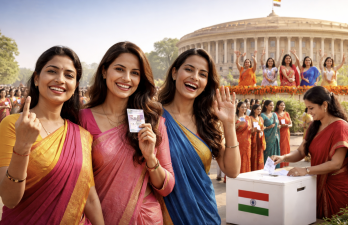
Women’s voting patterns in India have changed dramatically in recent years. By 2024, women voted almost as much as men, and in some State elections, even more. Despite this, women’s representation in Parliament remains low. This article explores the journey of women’s political participation from voting to holding power.
Women as Voters
After Independence, women voted less than men due to low literacy, restricted mobility, and family duties. In 1967, women’s turnout was 11.2 points lower than men’s. This gap narrowed steadily from the 1980s. By 2019 and 2024, women voted nearly equally to men. In State elections, women even outvoted men since 2011. This shows a long-term rise in women’s electoral participation.
Participation Beyond Voting
Women’s involvement in election campaigns is rising but still behind men. Attendance at rallies and door-to-door canvassing by women doubled since 2009 but remains half of men’s participation. Family permission limits women’s public political activities. Social norms restrict women’s full engagement in politics beyond voting.
Women’s Representation in Parliament
Women’s presence in Lok Sabha has grown slowly. From just 22 women MPs in 1952, numbers rose to a peak of 78 in 2019, then slightly fell to 74 in 2024. Even at peak, women made up only 14% of MPs. Women candidates have increased but remain a small minority. Success rates of women candidates are often higher than men’s, disproving claims of lower electability.
Barriers to Political Power
Women’s political autonomy is limited by family influence and societal expectations. Half of women voters consult family before voting. Many believe political families and wealth give women an advantage. Patriarchy, household duties, lack of confidence, and financial constraints restrict women’s political rise. The Women’s Reservation Bill aims to improve representation but faces implementation challenges.
Topics for Prelims:
Women’s Voter Turnout Trends
- Post-Independence, women’s turnout was lower than men’s.
- The gender gap narrowed from 1980s onwards.
- Women’s turnout reached near parity with men by 2019-24.
- Women’s turnout surpassed men in many State elections after 2011.
- Structural factors like literacy and mobility initially limited turnout.
Women’s Political Representation
- Women MPs in Lok Sabha rose from 22 in 1952 to 74 in 2024.
- Women candidates increased from 45 in 1957 to 800 in 2024.
- Women’s electoral success rates often exceed men’s.
- Women constitute about 14% of Parliament despite near-equal voting.
- Political parties nominate fewer women citing electability concerns.
Barriers to Women’s Political Participation
- Family permission limits women’s campaign involvement.
- Patriarchy is the biggest obstacle to political participation.
- Household responsibilities restrict women’s political activity.
- Lack of confidence and awareness affect women’s political roles.
- Political opportunities favour men and women from political families.
Questions for Mains:
- Discuss in the light of women’s electoral participation in India, the factors responsible for the gender gap in political representation. [GS-II-Constitution of India & Polity]
- Analyse the impact of social and familial norms on women’s political autonomy in India, with examples from recent elections. [GS-I-Indian Society]
- Examine the role of political parties in shaping women’s representation in Indian legislatures and discuss measures to improve it. [GS-II-Governance]
- With suitable examples, critically discuss the significance of the Women’s Reservation Bill in enhancing women’s political empowerment in India. [GS-II-Social Justice]
Answer Hints:
1. Discuss in the light of women’s electoral participation in India, the factors responsible for the gender gap in political representation. [GS-II-Constitution of India & Polity]
- Women’s voter turnout has reached near parity with men, but representation in Parliament remains low (~14%).
- Limited female candidature and party nominations create a nomination bottleneck.
- Political parties often cite electability concerns, though women’s success rates are comparable or higher than men’s.
- Social and structural barriers – patriarchy, household responsibilities, lack of confidence, and financial constraints.
- Women’s political autonomy is constrained by family influence and societal expectations.
- Systemic biases within political institutions favor men and women from political families or higher economic status.
2. Analyse the impact of social and familial norms on women’s political autonomy in India, with examples from recent elections. [GS-I-Indian Society]
- Many women require family permission to participate in campaign activities (rallies, meetings, canvassing).
- About 50% of women voters consult family before voting, indicating limited voting autonomy.
- Majority (52%) consider sharing family’s political views important, showing influence of familial alignment.
- Social norms restrict women’s public political engagement despite rising voter turnout.
- Patriarchal attitudes and domestic roles limit women’s visibility and active participation beyond voting.
- Examples – Women’s campaign participation remains half that of men despite increase since 2009.
3. Examine the role of political parties in shaping women’s representation in Indian legislatures and discuss measures to improve it. [GS-II-Governance]
- Political parties nominate fewer women candidates, citing electability concerns.
- Data shows women’s electoral success rates are equal or better than men’s, disproving electability myths.
- Parties prefer male candidates and those from political families, limiting women’s access.
- Measures – Implement internal party quotas for women candidates to increase nominations.
- Strengthen party-level capacity building and political training for women leaders.
- Promote transparency and accountability in candidate selection processes to reduce bias.
4. With suitable examples, critically discuss the significance of the Women’s Reservation Bill in enhancing women’s political empowerment in India. [GS-II-Social Justice]
- The Bill proposes 33% reservation for women in Parliament and State Assemblies to address underrepresentation.
- It provides a structural solution to the nomination bottleneck and systemic gender bias.
- Women’s current representation (~14%) is far below their electorate share (~50%), showing need for affirmative action.
- Critics argue it may benefit women from political families, not grassroots leaders.
- Implementation challenges and political resistance have delayed its enactment.
- Overall, the Bill is a key step toward political empowerment but must be complemented by social and institutional reforms.